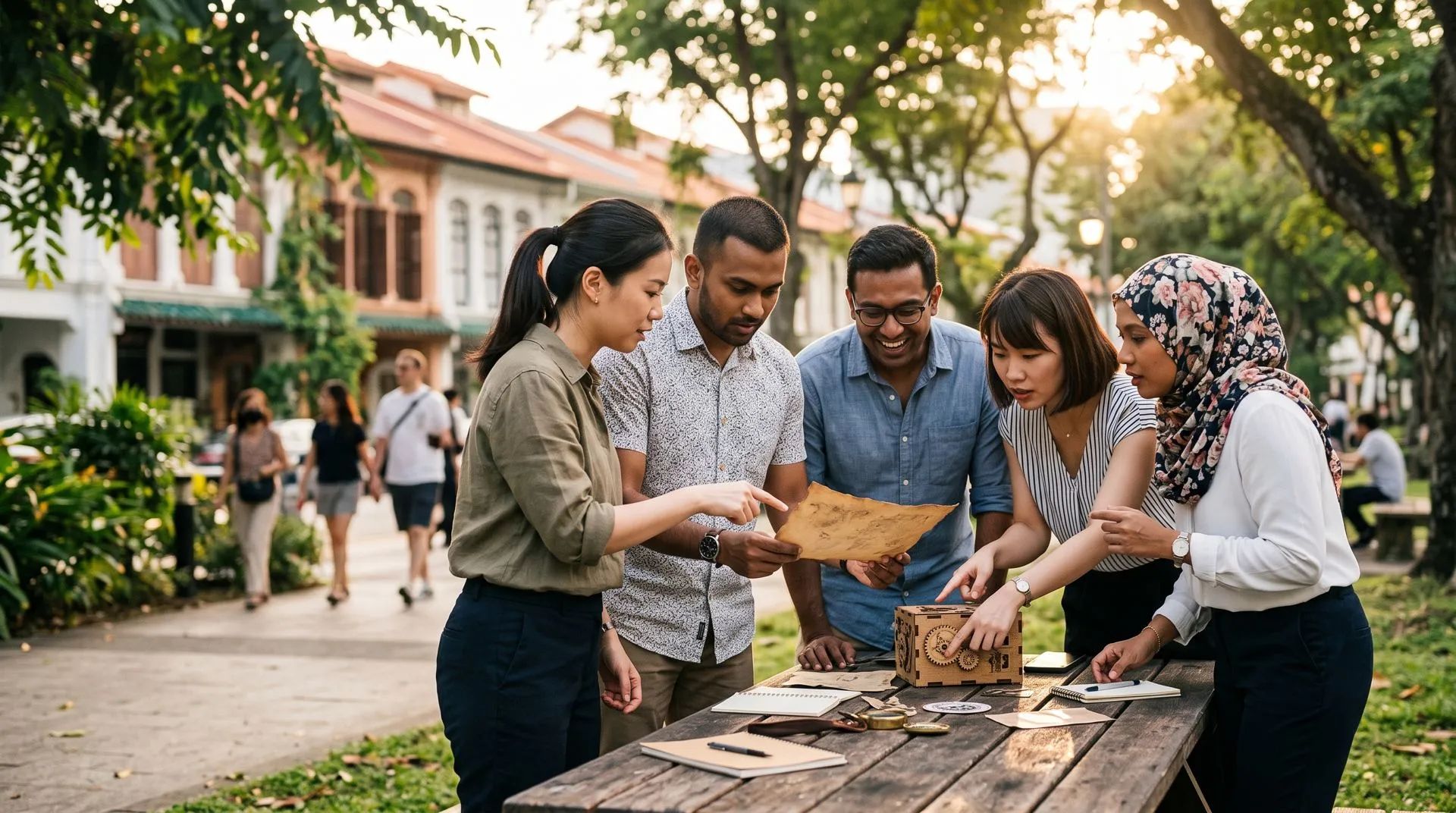
Here are 30 team bonding activities in Singapore, from free office games to facilitated events for 1,000 pax, each with a group size, time and price band. About a third come in under SGD 25 per pax, a third sit between SGD 25 and 50, and a third run higher. Headcount moves the price most.
| Per pax | Activities (item number) | Group sizes |
|---|---|---|
| Under SGD 25 | Offsite escape games on Standard above 60 pax (1), telematch run by your own committee (4), inflatable obstacle course (5), build challenges you run yourself (14), a hawker trail you write yourself (16), bubble soccer (22), nature trail (28), the no-budget list (30) | Any size, up to 1,000+ |
| SGD 25 to 50 | Offsite escape games at 10 to 60 pax (1), amazing race (2), game show (3), telematch run by a vendor (4), terrarium (7), art jamming (8), candle or soap making (10), batik (12), laser or archery tag (21), bowling (23), indoor climbing (24), trampoline park (25), CSR builds (29) | 10 to 500, route games to 1,000+ |
| Over SGD 50 | Beach or island day (6), pottery (9), perfume (11), leather or woodcraft (13), cooking class (15), guided food trail (16), cocktails (17), coffee (18), tastings (19), cook-off (20), dragon boating (26), kayaking or raft building (27) | 8 to 300, most under 80 |
How to read the prices. Every band is per pax and indicative, drawn from public Singapore listings checked in October 2026. None of them is a quote. The same activity swings with the venue, weekday versus weekend, and headcount, and a small group often meets a minimum spend that pushes its per-head figure up. Check GST too. We are not GST registered, so the price we quote is the price paid.
Most lists stop at a name and a stock photo. This one gives every entry the same four lines: who it suits, how long it takes, roughly what it costs a head, and the catch. We run item 1 for a living, which we have flagged, so read it with that bias. The other 29 we have watched teams do for over a decade.
Two rules that decide everything
It has to run in parallel. For a large group, that means the same experience, many teams, one venue, one day. If it takes one small group at a time, it is not a large-group activity no matter how good it is.
Everyone plays. If a third of the room ends up spectating, what you paid for was entertainment.
Shortlist by goal
| If you need | Start with | Why |
|---|---|---|
| 100 to 1,000+ pax on one date | Offsite escape games (1), amazing race (2), telematch (4) | Many teams play at once, so nobody queues or watches |
| Under SGD 25 a head | The no-budget list (30), a hawker trail you write (16), an offsite escape game above 60 pax (1) | Low fixed costs, or fixed costs split across a crowd |
| A quiet team | Offsite escape games (1), batik (12), coffee (18) | Small tables, a task to talk about, nobody on a stage |
| A dinner and dance (D&D) evening | Corporate game show (3), an offsite escape game played table by table (1) | Both work seated, at the dinner tables |
| A rainy day | Bowling (23), laser or archery tag (21), art jamming (8), an indoor offsite escape game (1) | All indoors, all aircon |
| An energetic team | Bubble soccer (22), laser or archery tag (21), dragon boating (26) | Loud, physical and scored |
| A whole day and good weather | Beach or island day (6), dragon boating (26), amazing race (2) | The Singapore you only get outdoors |
| A family day | Telematch (4), inflatable obstacle course (5), hawker trail (16) | A range of ages can all join |
| A CSR day | CSR builds and volunteering (29) | The work goes to a partner who needs it |
Three of those rows have a longer guide of their own: cheap team bonding under SGD 50 a head, dinner and dance (D&D) games for 100+ pax and indoor activities for any weather. For a ballroom D&D, Journey into the Unknown runs at any indoor venue for up to 300 pax in 90 minutes, on Immersive only. For a family day or a conference energiser, keep it short and parallel, with no long briefing.
Big-group formats
Six formats on this list hold up past 100 people, because many teams can play the same thing at the same time.
1. Offsite escape games
An offsite escape game is a facilitated game where teams solve a case against a clock at a venue, rather than in a fixed room. It scales because many teams play the same case at once. We have run escape games in Singapore since 2013 and now run them only offsite, so weigh this entry accordingly.
- Suits: 10 to 1,000+ pax. Offsites, dinner and dance (D&D) nights, conferences, family days.
- Time: 120 minutes for most of our games, and 90 to 150 across the range.
- Roughly: a game fee of SGD 300 fixed plus SGD 20 a head on Standard (Self-guided). That is SGD 900 for 30 pax, SGD 30 a head, and SGD 2,300 for 100 pax, about SGD 23 a head. Immersive, which adds costumed facilitators around the venue, is SGD 1,100 fixed plus SGD 20 a head. Some venues add an admission or venue fee on top of the game fee.
- The catch: the fixed part. At 10 pax the game fee works out to SGD 50 a head. And a retail walk-in escape room is the opposite of this format. It seats eight, so check the game was built to run in parallel.
Lost Treasure of Sarang Rimau takes up to 1,000 pax across Fort Siloso on Sentosa, which is free to enter. See all our games, read how the format works, or get a quote for your headcount.
2. Amazing race or city route game
An amazing race is a route game: teams move between checkpoints across a district or large venue, solving a clue at each, scored on time.
- Suits: 20 to 1,000+ pax who want to be outdoors and moving.
- Time: 2 to 4 hours.
- Roughly: SGD 30 to 60 a head, plus admission where a checkpoint sits inside an attraction.
- The catch: bottlenecks. Ask how a big field is staggered so 600 people are not queueing at checkpoint three.
Plenty of briefs that arrive with the words “amazing race” turn out to want a story with puzzles in it, which is an outdoor escape game. How the two differ.
3. Corporate game show
A corporate game show is a hosted quiz-and-challenge format: a host, a scoreboard, teams at tables. It fits inside a dinner without moving anyone, which is why it survives on every D&D run sheet.
- Suits: 30 to 500 pax, seated.
- Time: 45 to 90 minutes.
- Roughly: SGD 20 to 45 a head for the host and the game, before the dinner.
- The catch: it entertains more than it bonds. Strong as a segment, thin as a whole offsite.
4. Telematch or office olympics
Telematch is a day of station-rotation games: captain’s ball, relays, tug of war. Cheap, loud, endlessly scalable.
- Suits: 30 to 500 pax with a field or a big hall.
- Time: 2 to 3 hours.
- Roughly: under SGD 10 a head if your own committee runs it, or SGD 25 to 45 with a vendor running the stations.
- The catch: anyone who cannot or does not want to run. Give them scoring or referee roles rather than a bench.
5. Inflatable obstacle course
An inflatable obstacle course is a hired bouncy course that teams race through in heats. Big, silly, physical, and it works as one station in a family-day setup.
- Suits: 30 to 300 pax in rotations.
- Time: a half-day hire, run as short heats.
- Roughly: SGD 10 to 30 a head, because the hire is a flat fee split across the crowd, plus space to put it.
- The catch: it is a rotation. Plan what the waiting two thirds are doing.
6. Beach or island day
A beach or island day takes the team to Sentosa, East Coast or Pulau Ubin, with games layered on top.
- Suits: 40 to 300 pax, full day.
- Time: 6 to 8 hours with travel.
- Roughly: SGD 50 to 120 a head once transport, food and a run programme are in.
- The catch: heat and shade. A Singapore beach at 2pm is not neutral ground for everyone.
Make something
Craft workshops in Singapore run from about SGD 30 to 150 a head, and most suit 8 to 80 pax at tables. They are calm and tactile, and everyone leaves with an object. The trade-off is that people mostly talk to their own table.
7. Terrarium building
A terrarium workshop has each person build a small glass garden. The desk souvenir keeps the day alive for months.
- Suits: 10 to 80 pax at tables.
- Time: 1.5 to 2 hours.
- Roughly: SGD 35 to 60 a head, materials in.
- The catch: pleasant, but it will not do much bonding on its own.
8. Art jamming
Art jamming is a group painting session: canvases and paint, no skill needed. More mess and more laughing than terrariums.
- Suits: 10 to 60 pax.
- Time: 2 to 3 hours.
- Roughly: SGD 30 to 50 a head, depending on canvas size.
- The catch: quiet groups stay quiet.
9. Pottery or clay
A pottery session is wheel-throwing or hand-building in a studio. Genuinely absorbing and genuinely slow.
- Suits: 8 to 40 pax.
- Time: 2 to 3 hours.
- Roughly: SGD 50 to 90 a head, with glazing and firing sometimes extra.
- The catch: studio capacity is the hard limit, and firing means the piece arrives weeks later.
10. Candle or soap making
Candle or soap making means picking scents, pouring and labelling your own. Fussier than it sounds and quietly competitive.
- Suits: 10 to 50 pax.
- Time: 1.5 to 2 hours.
- Roughly: SGD 35 to 60 a head.
- The catch: strong scents in a small room, and anyone with sensitivities.
11. Perfume blending
Perfume blending has each person build a scent from a perfumer’s base notes. Same shape as candles, more of a talking point, and it feels premium.
- Suits: 10 to 40 pax.
- Time: 1.5 to 2 hours.
- Roughly: SGD 60 to 120 a head, mostly set by the bottle size.
- The catch: as above on scent, and it caps out small.
12. Batik or heritage craft
Batik is wax-resist painting on cloth, one of several local crafts that add a cultural layer and land well with mixed nationalities.
- Suits: 10 to 60 pax.
- Time: about 2 hours, plus drying.
- Roughly: SGD 35 to 65 a head.
- The catch: drying time, and dye on clothes. Warn people not to wear white.
13. Leather or woodcraft
Leather or woodcraft workshops make wallets, keychains and small boxes. Popular with teams that liked the terrarium but wanted something sturdier.
- Suits: 8 to 30 pax.
- Time: 2 to 3 hours.
- Roughly: SGD 60 to 150 a head, depending on the piece.
- The catch: the smallest capacity on this list. Really a small-team option.
14. Build challenges
A build challenge gives teams a physical constraint and a spec to hit: bridges from newspaper, spaghetti towers, marble runs, cardboard boats.
- Suits: 20 to 200 pax at tables.
- Time: 45 to 90 minutes.
- Roughly: under SGD 15 a head in materials if you run it, or SGD 30 to 50 with a facilitator.
- The catch: runs short, and can feel like a school activity if the framing is thin. Better as one segment.
Food and drink
Food-based team bonding in Singapore mostly costs SGD 55 to 150 a head, with a hawker trail you write yourself as the cheap exception. The eating does half the work, and almost all of these cap out on kitchen capacity.
15. Cooking or baking workshop
A cooking workshop has teams make a dish together and then eat it: pizza, dumplings, sambal, local kopi. Hands-on and social.
- Suits: 10 to 80 pax across stations.
- Time: 2.5 to 4 hours, eating included.
- Roughly: SGD 70 to 120 a head, rising fast at premium venues.
- The catch: kitchen capacity. Most cannot take a department at once.
16. Hawker or heritage food trail
A hawker trail is an eating route through a hawker centre or heritage district, either written by you or led by a guide.
- Suits: 15 to 80 pax in pods.
- Time: 2 to 3 hours.
- Roughly: SGD 15 to 25 a head if you write the route, which is the food, or SGD 60 to 90 with a guide.
- The catch: dietary requirements, and pods drifting apart. It needs a clear finish point.
17. Cocktail or mocktail mixing
A mixology class has a bartender teach the team to shake, taste and compare. Reliably loosens a room.
- Suits: 10 to 60 pax.
- Time: 1.5 to 2 hours.
- Roughly: SGD 55 to 100 a head.
- The catch: have a proper non-alcoholic track, not an afterthought. It matters more here than anywhere else on the list.
18. Coffee or latte art
A coffee workshop covers tasting, pulling shots and pouring rosettas. A good morning-slot option.
- Suits: 10 to 40 pax.
- Time: 1.5 to 2 hours.
- Roughly: SGD 60 to 120 a head.
- The catch: small capacity, and everyone is wired by lunch.
19. Wine, sake or tea appreciation
A guided tasting puts the team in front of someone who knows the subject.
- Suits: 12 to 50 pax, seated.
- Time: 1.5 to 2 hours.
- Roughly: SGD 60 to 150 a head, mostly what is poured.
- The catch: it is a seated talk. Lovely, but low on interaction.
20. Cook-off competition
A cook-off has teams cook against each other to a brief and get judged. The competitive version of a cooking class.
- Suits: 20 to 100 pax across stations.
- Time: 3 to 4 hours.
- Roughly: SGD 70 to 130 a head.
- The catch: it needs real kitchen infrastructure or a well-run mobile setup.
Get moving
Active team bonding in Singapore costs SGD 15 to 60 a head and suits 10 to 120 pax, usually in rotations. This is physical and competitive, and it is where inclusion goes wrong most often.
21. Laser tag or archery tag
Laser tag and archery tag are short arena rounds, competitive without demanding much fitness.
- Suits: 15 to 120 pax in rotations.
- Time: 1 to 2 hours.
- Roughly: SGD 25 to 40 a head. The low figure usually assumes a bigger group.
- The catch: rounds per hour. Ask how many fit in your window before everyone has played twice.
22. Bubble soccer
Bubble soccer is football played inside inflatable bubbles. Nobody is good at it, which is the point.
- Suits: 20 to 100 pax in rotations.
- Time: 1 to 2 hours.
- Roughly: SGD 15 to 35 a head.
- The catch: knees and backs, and it is a rotation.
23. Bowling
Bowling splits the group into lanes by itself, and the scoring runs itself. Unglamorous, and it works.
- Suits: 20 to 100 pax.
- Time: about 2 hours.
- Roughly: SGD 25 to 40 a head for two hours with shoe hire, more with food.
- The catch: peak-hour lane availability, and people only talk to their own lane.
24. Indoor climbing
Indoor climbing pairs people on a rope, and belaying forces a trust exchange that most activities only talk about.
- Suits: 10 to 40 pax.
- Time: about 2 hours.
- Roughly: SGD 35 to 60 a head with gear and instructors.
- The catch: fear of heights, and gym capacity. Have a real alternative ready.
25. Trampoline or adventure park
A trampoline or adventure park session is a reserved block of jumping, climbing and obstacle zones. High energy, high photo count.
- Suits: 20 to 120 pax.
- Time: 1 to 2 hours.
- Roughly: SGD 20 to 40 a head, more with a team programme run by park staff.
- The catch: injury risk is genuinely higher here. Check the waiver situation with HR first.
Outdoors, the Singapore-specific ones
Singapore’s water and park activities cost from nothing to about SGD 80 a head and suit 20 to 200 pax, weather permitting. They photograph well and they date well.
26. Dragon boating
Dragon boating puts twenty-odd people in a boat who have to paddle in time or go nowhere. Few things make the coordination point this bluntly.
- Suits: 20 to 200 pax across boats.
- Time: 2 to 3 hours.
- Roughly: SGD 40 to 80 a head with boats, coaches and safety cover.
- The catch: swimming confidence, sun, and a fixed boat size. A 300-person team means a lot of waiting on the jetty.
27. Kayaking or raft building
Kayaking takes teams through mangroves or across a reservoir. Raft building asks them to make something that floats with people on it.
- Suits: 20 to 120 pax.
- Time: 2 to 3 hours.
- Roughly: SGD 40 to 70 a head with an instructor.
- The catch: weather cancellations are real here, unlike most of this list.
28. Nature trail or park connector challenge
A trail challenge is a reservoir loop, a Southern Ridges walk or a Pulau Ubin cycle, with tasks along the way.
- Suits: 20 to 150 pax.
- Time: 2 to 3 hours.
- Roughly: under SGD 10 a head, for water, first aid and prizes.
- The catch: fitness spread and the heat. Start early or go late.
Give something back
CSR team bonding in Singapore costs about SGD 30 to 70 a head, and most of that is materials for the partner.
29. CSR builds and volunteering
A CSR build has the team pack food bundles, refurbish a space, or assemble bikes or wheelchairs for a charity partner.
- Suits: 20 to 300 pax, and any team that wants the day to mean something beyond itself.
- Time: 2 to 4 hours.
- Roughly: SGD 30 to 70 a head, mostly materials.
- The catch: line up the partner early, and make sure the work is genuinely needed rather than staged. People can tell. More on CSR days.
Cheap and free
Free team bonding works at any size, as long as someone runs it properly. For paid options under SGD 50 a head, see 12 cheap team bonding activities in Singapore.
30. The no-budget list
Office olympics with what is already in the pantry. A “failure forum” where people present something that went wrong and what they learned. Two truths and a lie, run properly with mixed tables. A sunrise walk at a nature reserve before work. A rotating lunch roulette that pairs people who never talk.
- Suits: any size, any budget.
- Time: 15 minutes to an hour each.
- Roughly: free.
- The catch: these need someone to actually run them with conviction. Announced by email, they die.
Four questions to ask any vendor
- How many people can genuinely play at once? Not “capacity”, which often means how many can stand in the room.
- What happens to a team that gets stuck or falls behind? A good answer involves a facilitator. A bad answer is silence.
- How many of your staff are on site on the day? Ask for a number, not a list of activities.
- What is the plan if it rains or the venue changes? If it is improvised on the call, it will be improvised on the day.
The honest bottom line
For a large team where the goal is genuine bonding, a parallel format where everyone has a role beats a rotation of stations most of the time. That is why offsite escape games are our whole business, but the rule holds whatever you pick: runs in parallel, everyone plays. If you are sizing up formats for a group of 100 or more, our guide to team building activities in Singapore for big groups goes through them by scale.
Planning for a big group? See our corporate team bonding options, get an instant quote for your headcount, or request a proposal with a rough date.
Questions people ask
How many people do you need for a team bonding activity?
Most team bonding activities in Singapore work from about 10 pax, and the format sets the ceiling. Workshops and tastings usually cap at 40 to 80, because one facilitator can only cover so many tables. Rotation games like laser tag reach about 120. For 200 to 1,000+ pax you need something that runs in parallel, such as an offsite escape game or a staggered route game, so everyone plays at the same time.
How much should I budget per pax for team bonding in Singapore?
Budget SGD 25 to 50 per pax for a facilitated activity, under SGD 25 if you run it yourself or have a big group, and over SGD 50 for premium workshops, cooking, tastings or water sports. Headcount moves the figure most, because fixed costs get split across the group. Before you compare quotes, ask whether each one includes venue hire, admission and GST, since those three change the total more than the activity does.
Should team bonding in Singapore be indoor or outdoor?
Indoor is the safer default in Singapore, because heat and sudden storms are the two things most likely to spoil an outdoor day. Outdoor works well if you start early or late, keep shade and water close, and agree a wet weather plan in advance. Our outdoor escape games have sheltered hold points and pause the clock when it rains. Mixed fitness levels are another reason to stay indoors.
How far ahead should you plan a team bonding event?
As early as the venue allows. The lead time depends on when the venue, studio or facilitators are free on your date, not on how many people are coming. Year-end dinner and dance (D&D) dates from October to December fill earliest, so start sooner if your event falls then. Settle a date and a headcount range first, because venues, studios and facilitators all quote against those two numbers, and everything else follows from them.
What counts as team bonding?
Team bonding is any shared activity whose main goal is the relationship between colleagues rather than a work skill. In Singapore, team bonding and team building are used for the same booking, and the difference is the aim. A simple test: if everyone had a part to play and the team still talks about it the following week, it bonded. If a third of the room watched, it was entertainment.
What are some free team bonding ideas in Singapore?
Free team bonding ideas that work include an office olympics with pantry supplies, a lunch roulette that pairs people who rarely talk, two truths and a lie at mixed tables, a failure forum where people share a mistake and what they learned, and an early walk at a nature reserve. They cost nothing, but each needs someone to run it with conviction. Announced by email, they die.