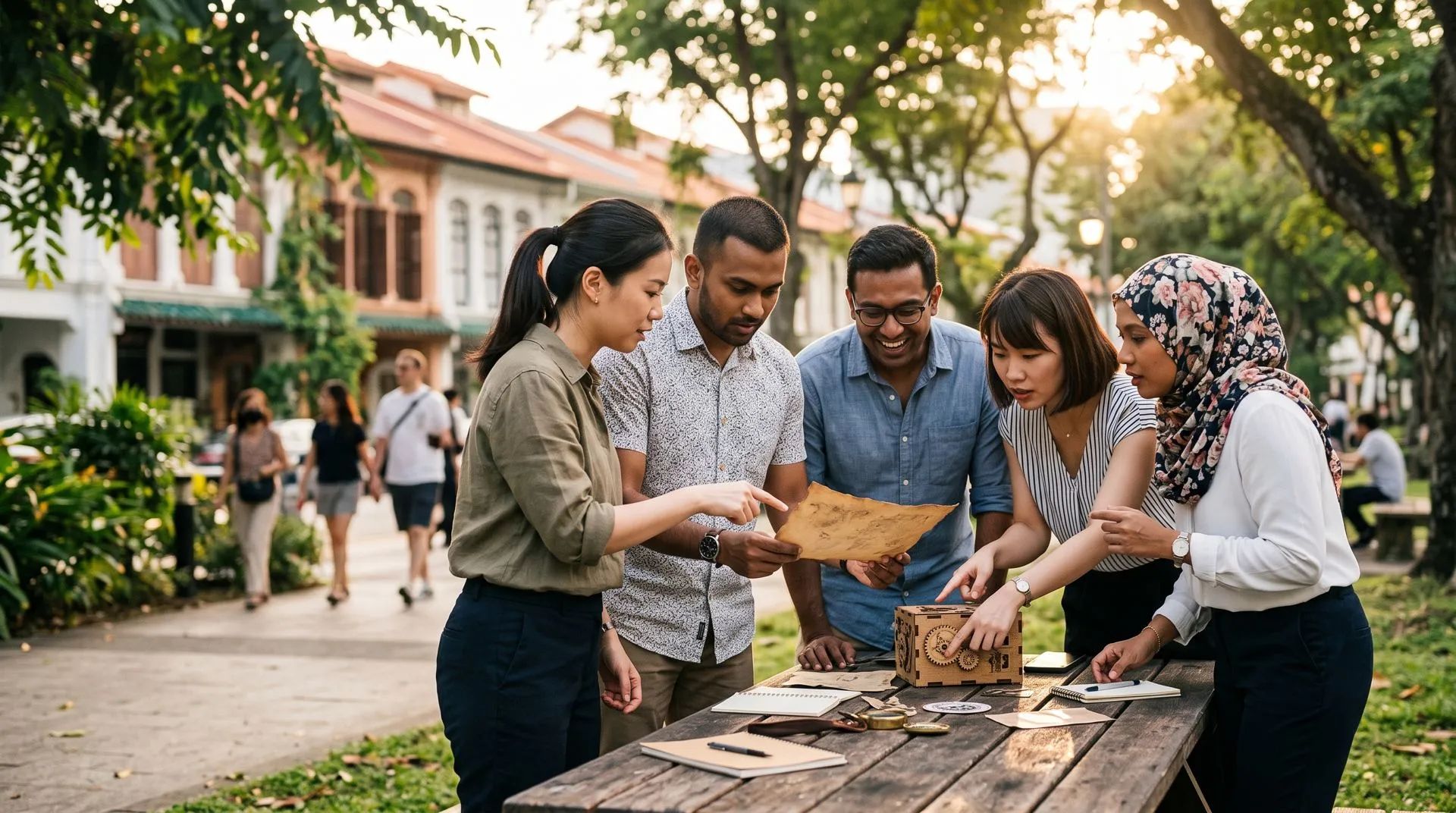
Team building is a planned activity meant to improve how a team works together, usually aimed at one named skill such as communication or making decisions under pressure. It often comes with a facilitator and a debrief, and you judge it by how the work goes afterwards.
Team bonding is time a team spends together so colleagues get to know and trust each other, with no skill target attached. It can be a game or a long lunch. You judge it by whether people ask each other for help more readily the week after.
In Singapore the two words are used for the same booking. The difference is the goal.
So a vendor, a venue or a procurement form that says one almost always covers the other. What changes is what you ask the day to do. And most of the time, when a manager says “we need team building”, the result they describe is bonding. The team communicates fine. What worries them is that half of it has never had a proper conversation.
Team bonding vs team building, side by side
| Team building | Team bonding | |
|---|---|---|
| Goal | One skill gets better, such as handoffs or decisions under pressure | People know and trust each other more |
| Format | Structured and led by a facilitator, usually with a debrief and a takeaway | Looser: shared time and a shared task, with no lesson at the end |
| Examples | A problem-solving workshop; an offsite escape game followed by a debrief on how the teams split the work | A long lunch or a cooking class; an offsite escape game played for the win, with no debrief |
| When to use it | A new team, or a known gap such as work that keeps falling between two departments | A team that sits together but doesn’t really know each other, or a group just after a hiring wave |
| How you measure it | Before and after on the skill, such as fewer dropped handoffs, plus what the debrief said to change | Whether people mix across teams and ask each other for help in the weeks after |
The same offsite escape game turns up in both columns on purpose. The booking can be identical. The goal decides what you do with it.
What team bonding means on the day
Team bonding means colleagues spending long enough on one shared problem that they see how each other think. You can’t lecture people into liking each other. It happens sideways, while everyone is busy with the same thing, which is why a shared task under a bit of pressure does more than a session titled “getting to know you”.
Team building, when the gap is real, looks different. If a new team keeps stepping on each other’s work, a structured workshop with a facilitator makes sense, and the debrief is the part that matters: it’s where the skill gets named and carried back to the office.
A quick way to decide
Ask what would count as success.
- If success is “the team now does X better”, you want team building. Plan something structured and keep time for a debrief.
- If success is “the team actually gets on now”, you want team bonding. Plan something they’ll still be talking about next week.
For most Singapore teams we run games for, it’s the second one. The brief says team building, but the win they describe is bonding. We cover the skill side of team building in Singapore for whole companies, and the relationship side on our team bonding in Singapore page.
One format that covers both
An offsite escape game does both jobs without making a show of either.
The skill part is built in. To finish, a team has to split up, share what it finds, delegate and make decisions with the clock running. Nobody announces “now we are practising communication”, but that’s what is happening.
The bonding part is why people remember it. You learn more about a colleague in two hours on one case than in a year of stand-ups: who stays calm when it goes wrong, and who spots the pattern first. Because everyone has a role, nobody is a spectator. The quiet person from finance who never speaks in meetings often turns out to be the one who cracks the final lock. People notice. It changes how they see each other on Monday.
Which way it leans is up to you. If you want the skill side named, hold a short debrief afterwards on how each team split the work. If you don’t, let people enjoy the win. A game such as Two Pieces at the Singapore Maritime Gallery runs either way, for up to 200 people on the same case at once.
Running it for a large group
Bonding a whole department is harder than bonding a team of eight, because you can’t put 200 people through one small activity and expect them all to take part. The format has to run in parallel: many small teams playing the same game at the same venue, so nobody sits out. We go through the options that hold up at that size, with prices and group sizes for each, in 30 team bonding activities in Singapore.
Our offsite escape games run for 10 to 1,000+ pax, at your own venue or at landmarks such as Fort Siloso on Sentosa and the Asian Civilisations Museum. The game fee is a fixed SGD 300 plus SGD 20 per person on Standard, so 100 pax comes to SGD 2,300, about SGD 23 a head. Immersive is SGD 1,100 fixed plus the same SGD 20 a head, and adds costumed facilitators around the venue. Some venues add an admission or venue fee. We are not GST registered, so the price quoted is the price paid.
If bonding is what you’re after, that’s our whole job. Get an instant estimate for your headcount, or request a proposal and we’ll scope it for your group.
Questions people ask
What does team bonding mean?
Team bonding means time a team spends together so colleagues get to know and trust each other, with no skill target attached. A shared game, a long lunch or a day out all count, as long as everyone takes part. In Singapore the phrase is used for the same events as team building; the difference is that the goal is the relationship, where team building aims at a skill.
What is another word for team bonding?
Team building is the word most often used in Singapore for the same thing, and you will also hear staff bonding, team outing and company outing. Strictly, team building aims at a skill and team bonding at the relationship, but vendors, venues and procurement forms treat them as one category. Search under both when you put a shortlist together.
Which one does my team need, team building or team bonding?
Choose team building if you want one skill to improve, such as handing work between departments or deciding faster, and hold a debrief afterwards. Choose team bonding if success means people getting on and asking each other for help. Most Singapore briefs we see say team building but describe bonding, so check which result you are actually after.
Is an escape game team building or team bonding?
An offsite escape game is both. Teams have to split up, share what they find and make decisions against a clock, which is the skill side. Everyone plays at once and wins or loses together, which is the bonding side. Hold a short debrief afterwards and it leans towards team building; leave it at the scores and it leans towards bonding.
How much does a team bonding escape game cost in Singapore?
Our offsite escape games cost a fixed SGD 300 plus SGD 20 per person on Standard, so 100 pax comes to SGD 2,300, about SGD 23 a head. Immersive is SGD 1,100 fixed plus SGD 20 per person and adds costumed facilitators. Some venues add an admission or venue fee on top. We are not GST registered, so the price quoted is the price paid.
How big a group can do team bonding together?
Any size, as long as the format runs in parallel. Our offsite escape games take a minimum of 10 pax and have run for more than 1,000 on a single day, with the group split into small teams playing the same game at once. The ceiling depends on the game: 1,000 at Fort Siloso, 300 for Journey into the Unknown at your own venue.