

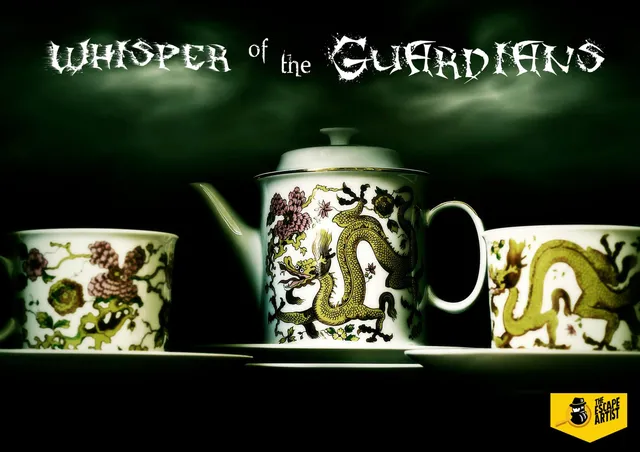
Whisper of the Guardians
An outdoor heritage escape game through Chinatown for up to 200, racing to decipher a wartime scroll before rival treasure hunters.
Venue ChinatownMax players Up to 200 pax
We have gone fully offsite. For a physical escape room, visit Lockdown Escape at Marina Square.
Amazing race team building in Singapore
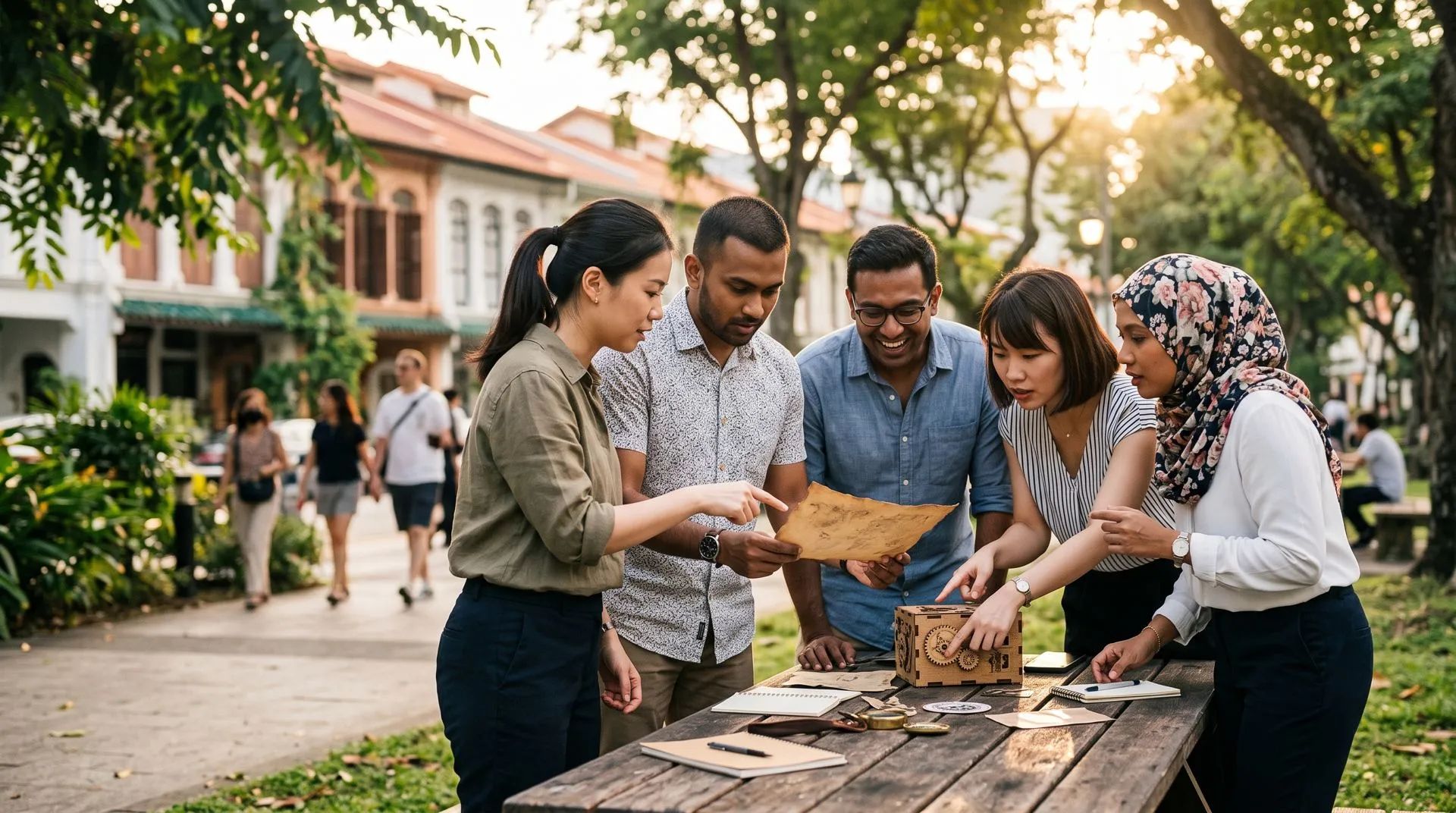
Teams out on real Singapore ground, moving between checkpoints, solving a clue at each one and racing the clock and each other. The difference is the story. Instead of unrelated stations bolted together, every route is one case that runs from the first checkpoint to the last, with our facilitators posted along the way. Ten pax or a thousand. It doubles as a team bonding day when that is the word on the brief.
Sort the words out first
Four words get used for one booking, and the differences decide how the day feels. Here is how we use them.
A list of things to find or photograph, in any order you like. Easy to run, easy to fake, and it ends the moment the list does.
A chain of clues where each answer points to the next place. Linear, so a stuck team stays stuck until someone helps them.
Checkpoints with a task at each one, scored on time, with teams racing each other as well as the clock. More moving parts, more staff, more atmosphere.
An escape game taken out of the room and onto real ground. Ours are all three of the above at once: a clue chain with staffed checkpoints, scored on time, wrapped in one story. If you searched for an outdoor escape room in Singapore, this page is the thing you were looking for.
Ours are races with a treasure-hunt spine: a clue chain that has to be solved in order, staffed checkpoints that score on time, and a story holding it together. We are an independent Singapore company and have no connection to the television series of a similar name. We use the phrase the way HR teams here use it, as the name of a format.
Before you brief it
That is not a criticism, it is just where the phrase comes from. The series ran for years and it is the only reference most Singapore HR teams have for the format, so "amazing race" has become the default way to ask for a day out with teams, checkpoints and a clock.
The second column is our standard escape game, and it is what we run most often. We do run genuine races, and Race to Infinity is exactly that, for up to 500 pax at a venue of your choice. Tell us which day you are imagining and we will say plainly which one your brief describes, even when it is the cheaper one.
Four routes
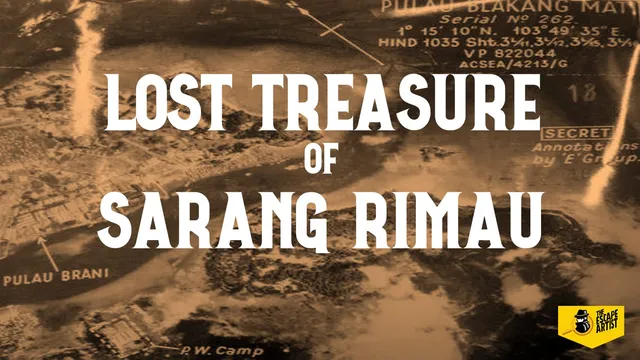
A route is not a map with tasks dropped on it. Each of these games was written for one place, so the clues only work there: a wartime scroll that has to be read against Chinatown's shophouses, a pirate cache hidden in the tunnels of a coastal fort.
What actually happens out there
Most team building puts the skills in a slide at the end. In a race, they are the only way to finish.
Each checkpoint is a puzzle the team has not seen before. There is no time to form a committee, so someone commits to an approach and the rest test it. That is the whole skill.
Teams are mixed across departments. By checkpoint three, the finance analyst is shouting a cipher across the street at someone from marketing whose name they learned an hour ago.
Two hours and a route that cannot be walked twice force delegation on the group. Nobody has to run a workshop on it.
Clues arrive out of order and some are red herrings. Teams have to move before they are certain, then correct. Most work weeks look like this.
The part that breaks other races
Scale is where outdoor races usually fall over. Fifty people is a walk in the park. Six hundred is a logistics problem: one checkpoint jams and the whole field stacks up behind it. We split the group into teams and give each team its own order of stops, so every checkpoint sees a steady trickle rather than a crowd. Fort Siloso, Haw Par Villa and River Wonders each take up to 1,000 pax this way. It is the same method we have used since 2013.
On the record
★★★★★
We had a great experience with The Escape Artist. They offered a variety of well-planned packages for us to choose from and were very accommodating with advance bookings. Their briefing was clear and helpful, and everything went smoothly on the day of our event.
★★★★★
Our team had an amazing bonding day with the folks at The Escape Artist, from the time we communicated on booking the place (Thanks, Edrin!) right up to the event day (Thanks, Iris and team!). My colleagues and I enjoyed the fun experience due to the challenging puzzles, appropriate ambience and friendly staff.
★★★★★
The puzzles were very challenging and forced all of us to work and communicate together. Highly recommended as a team bonding activity.
Trusted across corporate, government and education
























How it works
Pick from 11 games and venues, or tell us your headcount and we will match one.
Catering, transport, prizes, extra activities. Build the day you want.
Our events team sends a tailored proposal with pricing and logistics.
Lock the date and venue. We handle facilitators, props and set-up.
Turn up and play. Our hosts run everything, with facilitators in costume on Immersive.
Good questions
Team building usually aims at a skill, such as communication or problem-solving. Team bonding aims at the relationship, so people leave actually knowing and trusting each other. A facilitated escape game does both at once: colleagues solve a shared case under a running clock, which builds the skill and the bond in the same afternoon.
An amazing race is an outdoor team game where small teams move between checkpoints across a district or venue, solving a clue or completing a challenge at each one, racing a clock and each other. Ours are story-led: instead of generic stations, teams follow one case through the real streets of Chinatown, the ramparts of Fort Siloso or the paths of Haw Par Villa, with facilitators stationed along the route. Groups run from 10 to 1,000+ pax.
A scavenger hunt asks you to find or photograph a list of things, in any order. A treasure hunt gives you a chain of clues where each answer points to the next place. An amazing race adds checkpoints with tasks and a live race element, so teams compete on time as well as on solving. Our outdoor games sit in the middle of all three: a clue chain with staffed checkpoints, scored on time, wrapped in a story rather than a worksheet.
Up to 1,000 pax at Fort Siloso, Haw Par Villa and River Wonders, and up to 200 through Chinatown. The group splits into teams and each team works the route in its own order, so the site never bottlenecks and nobody spends the morning queueing at one checkpoint.
Chinatown for a heritage street route, Fort Siloso on Sentosa for a coastal fort with tunnels and ramparts, Haw Par Villa for the most atmospheric park in Singapore, and River Wonders for a wildlife-park setting. Each location has its own game written for it, so the route and the story belong to that place rather than being dropped onto it.
Every outdoor route has sheltered hold points and the game pauses rather than ends, so teams wait out a passing shower and the clock stops for everyone. If the forecast is bad ahead of the day we will offer you an indoor game or a new date. We have been running these since 2013, and Singapore weather has not been a surprise yet.
Total cost is the game fee plus SGD 20 per person, plus any admission fee or venue hire. The game fee is SGD 300 for Standard, which is self-guided on our MazeFox app with one staff host, or SGD 1,100 for Immersive, which adds cosplay facilitators along the route. That works out from about SGD 23 per person for larger groups. We are non-GST registered, so there is no GST on top. There is an instant estimate at /get-a-quote.
Prefer to stay indoors, or need a game that runs at your own venue? The same case format runs inside as escape game team building, and every route can be built around your brand as a custom escape game.
Request a proposal
Tell us your group size, a rough date and whether it is corporate, government or education. We reply within one business day with a tailored proposal, no obligation.
Notice
Our HarbourFront outlet has closed. We now run escape games offsite only, as facilitated events for teams of 10 to 1,000+ pax at a venue you choose. There is no room here to book by the hour.