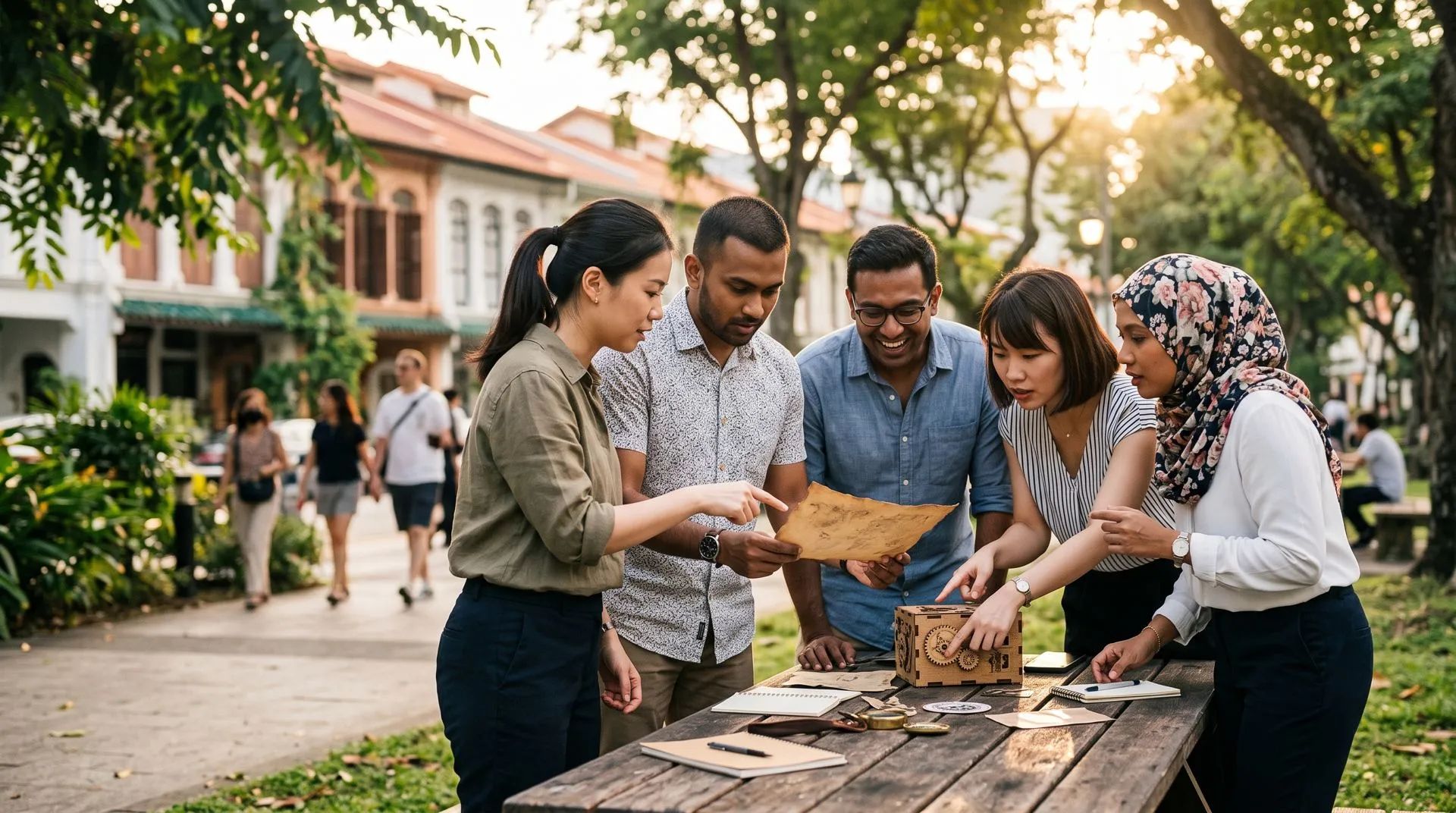
Quick answer: Indoor team building in Singapore runs from about SGD 15 a head for a hosted quiz to about SGD 110 for a perfume workshop, and an offsite escape game at an indoor venue costs about SGD 23 a head at 100 pax. Capacity narrows the shortlist faster than price does: most studios and kitchens cap out at 40 to 80 pax, while an escape game run in parallel takes 120 to 300.
| Activity | SGD per pax | Pax | The catch |
|---|---|---|---|
| Offsite escape game at an indoor venue | 30 at 30 pax, about 23 at 100 (game fee) | 10 to 200 | Each venue has its own fee type |
| Offsite escape game at your own venue | 42 at 50 pax, 31 at 100 (game fee) | 10 to 300 | Immersive only, higher fixed fee |
| Museum and gallery challenge | 25 to 60 | 20 to 150 | Visitor-flow rules |
| Cooking and baking workshop | 40 to 100 | 10 to 40 per kitchen | Kitchen capacity |
| Terrarium and plant workshop | 30 to 65 | 10 to 80 | Pleasant more than bonding |
| Art jamming | 30 to 45 | 10 to 60 | Quiet groups stay quiet |
| Perfume and candle making | 40 to 110 | 10 to 50 | Strong scents in a small room |
| Table quiz or game show | 15 to 40 | 30 to 500 | Entertains more than it bonds |
| Murder mystery dinner | 50 to 100, dinner extra | 10 to 60 | Rewards the confident |
| Bowling | 25 to 40 | 20 to 100 | Talk stays at each lane |
| Laser tag and archery tag | 25 to 40 | 15 to 120 | Half the group waits |
| VR arcade session | 20 to 55 | 10 to 60 | Headset count is the capacity |
Other vendors’ prices here are indicative bands drawn from public Singapore listings in October 2026, so ask for the figure at your real headcount. Ours come from our published formula.
In Singapore, “indoor” is not a nice-to-have. It is the sensible default. Midday heat, an afternoon downpour, or simply not wanting fifty colleagues melting in the sun. An indoor activity takes the weather off the risk list entirely. Here is what works inside, and the practical points that decide whether it holds up for a large group.
Why indoor is usually the right call
Two reasons beyond comfort. First, reliability: an outdoor plan needs a wet-weather backup, and the backup is almost always indoors anyway, so you may as well start there. Second, air-con and acoustics. For anything that involves briefing a big group or running a scoreboard, an indoor space you control beats an open field where half the room cannot hear.
Escape games and challenges
1. An offsite escape game at an indoor venue
An offsite escape game is a live case that teams solve against a clock at a real venue, with our staff running it. Five of ours are set inside venues that are indoor by nature: Artefact Temporis at the Asian Civilisations Museum, Two Pieces at the Singapore Maritime Gallery, Wonderland across VivoCity, Heart of the Ocean at the Oceanarium on Sentosa, and Code of Silence in Battlebox, the WWII bunker under Fort Canning. You get a striking setting with none of the weather worry.
- Suits: 10 to 200 pax depending on the game. Two Pieces takes 200, Artefact Temporis and Heart of the Ocean 150, Wonderland and Code of Silence 120.
- Time: 120 minutes.
- Roughly: our Standard tier is SGD 300 fixed plus SGD 20 a head, so the game fee is SGD 50 a head at 10 pax, SGD 30 at 30 and about SGD 23 at 100. Some venues add an admission or venue fee: the Singapore Maritime Gallery and VivoCity add nothing, the Oceanarium needs an admission ticket and Battlebox is a venue hire.
- The catch: each venue has its own capacity and its own fee type, and Code of Silence runs on Immersive only. We handle the venue booking as part of the proposal.
The venues guide has more on each place.
2. An offsite escape game at your own venue
Journey into the Unknown, our sci-fi escape game, runs at any indoor venue, including your office, a function room or a ballroom. We bring the game, the staff and the kit. You supply the room.
- Suits: 10 to 300 pax depending on the space.
- Time: 90 minutes.
- Roughly: Journey into the Unknown is Immersive only, so the game fee is SGD 1,100 fixed plus SGD 20 a head: SGD 42 a head at 50 pax, SGD 31 at 100 and about SGD 24 at 300. In your own office there is nothing on top. A hotel ballroom is the hotel’s bill.
- The catch: the fixed fee is SGD 800 higher than a Standard game, because Immersive adds facilitators in costume around the room. That gap matters at 30 pax and barely registers at 300. You also need a room big enough to seat every team at once, so tell us the space and the headcount and we will check it.
If running it on your own turf appeals, see the games that work at any venue.
3. Museum and gallery challenges
A museum or gallery challenge is a hosted task set run through a museum’s own galleries, so the exhibits become the material rather than the backdrop.
- Suits: 20 to 150 pax, and any group where “educational” needs to be a defensible word on the request form.
- Time: 90 minutes to 2 hours.
- Roughly: SGD 25 to 60 a head with a vendor running it, plus admission for anyone who pays it. The national museums are free for Singapore citizens and PRs, so foreign staff are usually the only admission cost.
- The catch: museums have visitor-flow rules and quiet hours. Confirm what a group is allowed to do before you plan around it.
Workshops at a table
4. Cooking and baking workshops
Pizza, dumplings, local kopi, sambal. Hands-on, social, and the eating at the end does half the work.
- Suits: smaller groups, usually 10 to 40 pax per kitchen, or large groups split across stations.
- Time: 2 to 3 hours.
- Roughly: SGD 40 to 100 a head. A simple dumpling or prata session sits at the bottom, a chef-led cook-off at the top.
- The catch: kitchen capacity, which is the hard limit. Most cannot take a whole department at once, and many carry a minimum spend.
5. Terrarium and plant workshops
Everyone builds a small glass garden and takes it home. Calm, tactile, and the thing sits on a desk for months afterwards.
- Suits: 10 to 80 pax at tables.
- Time: 60 to 90 minutes.
- Roughly: SGD 30 to 65 a head, depending on the container and the studio. Some providers bring the kit to your office.
- The catch: it is a pleasant afternoon more than a bonding engine. People talk to their own table and nobody else.
6. Art jamming
Canvases and paint, no skill needed. Same shape as the terrarium session with more mess and more laughing.
- Suits: 10 to 60 pax.
- Time: 2 to 3 hours.
- Roughly: SGD 30 to 45 a head, depending on canvas size.
- The catch: studio capacity, and the fact that quiet groups stay quiet.
7. Perfume and candle making
Pick notes, blend, pour, label. Fussier than it sounds and surprisingly competitive once people start comparing.
- Suits: 10 to 50 pax.
- Time: 90 minutes to 2 hours.
- Roughly: SGD 40 to 110 a head. Candles land at the bottom of that band and a full-size perfume at the top.
- The catch: strong scents in a small room, and anyone with sensitivities.
Seated games
8. Table quizzes and game shows
A host, a scoreboard, teams at tables. It fits inside a dinner without moving anybody, which is why it survives on every D&D run sheet.
- Suits: 30 to 500 pax seated. D&Ds and mingling sessions more than a standalone offsite.
- Time: 45 to 90 minutes.
- Roughly: SGD 15 to 40 a head for a hosted show, lower per head as the room fills.
- The catch: on its own it entertains more than it bonds. Good as part of a bigger day, thin as the whole thing.
9. Murder mystery dinners
Characters, private information, and a group that has to pool what it knows. The puzzle is social rather than mechanical.
- Suits: 10 to 60 pax, seated, usually over dinner.
- Time: 2 to 3 hours, across the meal.
- Roughly: SGD 50 to 100 a head for the game, with dinner on top.
- The catch: it rewards the confident. Quiet people can sit out the whole thing without anyone noticing.
Active and competitive
10. Bowling
Lanes split a group into small teams by themselves and the scoring runs itself. Unglamorous and it works.
- Suits: 20 to 100 pax, mixed ages and abilities.
- Time: 2 hours.
- Roughly: SGD 25 to 40 a head, including shoe hire.
- The catch: lane availability at peak times, and that people mostly talk to the five at their own lane.
11. Indoor laser tag and archery tag
Short competitive rounds in an arena. Physical without demanding much fitness.
- Suits: 15 to 120 pax in rotations.
- Time: 1 to 2 hours.
- Roughly: SGD 25 to 40 a head. The low figure usually assumes a bigger group and an off-peak slot.
- The catch: rounds per hour. Ask how many fit in your window before everyone has played twice, and plan what the waiting half is doing.
12. VR arcade sessions
Headsets set up karaoke-style so a group shares and takes turns. Our event partner V-Room runs this format, and so does Lava Floor with a team game played across glowing LED tiles.
- Suits: 10 to 60 pax in rotations.
- Time: 1 to 2 hours.
- Roughly: SGD 20 to 55 a head. Shared-headset arcades sit at the bottom and free-roam arenas at the top.
- The catch: headset count is the real capacity. Motion sickness for a few people, so have something else for them.
What to check before you commit to an indoor activity
- Capacity. The single most common trip-up. A room or studio that sounds fine for “a team” often caps out well below a full department.
- Parallel or not. For a large group, can everyone do it at the same time, or does the group split and take turns? Taking turns means people waiting.
- Setup and power. Anything with a scoreboard or AV needs the room to support it. Confirm early.
- Ceiling height and noise. Function rooms vary more than you would think, and a low ceiling kills anything with movement.
- Catering. Indoors usually makes food easier. Worth bundling in.
If you want outdoor, food and free ideas on the same shortlist, our 30 team bonding activities in Singapore, with prices and group sizes covers the wider field.
The bottom line
For a large indoor event where you want everyone bonding rather than taking turns, a parallel format beats a rotation of stations. An escape game run in your own space or at an indoor venue keeps the weather off the table and gives the whole group one shared experience.
Our games run for 10 to 1,000+ pax, from about SGD 23 per person for larger self-guided groups, and we are non-GST registered. See your indoor options, get an instant estimate, or request a proposal with your space and headcount.
Questions people ask
What are good indoor team building activities in Singapore?
The indoor formats that hold up best are an offsite escape game at a museum or in your own function room, cooking workshops, terrarium and art jamming sessions, table quizzes, murder mystery dinners, bowling, laser tag and VR arcades. For a whole department the escape game and the quiz work best, because everyone plays at once. Studios and kitchens suit groups under about 50.
How much does indoor team building cost per pax in Singapore?
Most indoor activities cost SGD 25 to 60 a head, with hosted quizzes as low as SGD 15 and perfume or cooking workshops reaching about SGD 100 to 110. An offsite escape game at an indoor venue is SGD 300 fixed plus SGD 20 a head on our Standard tier, about SGD 23 a head at 100 pax, before any admission or venue fee.
Which indoor activity works for 100 or more people?
An escape game run in parallel, or a hosted quiz at tables. Both keep everyone playing at the same time. Our indoor escape games take 120 to 200 pax at a museum, gallery or mall, and Journey into the Unknown takes up to 300 in your own ballroom or function hall. Most workshops, studios and kitchens cap out somewhere between 40 and 80, so a big group has to split.
Can we run team building in our own office?
Yes, if the room can seat every team at once. Journey into the Unknown, our sci-fi escape game, runs in an office, function room or ballroom for 10 to 300 pax over 90 minutes, and we bring the game, the staff and the kit. Quizzes and some terrarium and perfume workshops also travel to you. Check power, ceiling height and noise first.
Is indoor or outdoor team building better in Singapore?
Indoor is the safer default in Singapore. Midday heat and an afternoon storm can each wreck an outdoor plan, and that plan needs an indoor backup anyway, so many organisers simply start indoors. Outdoor still has its place for a group that wants to move and see a real landmark, provided the vendor has a written rain plan for the day.
How far ahead should we plan an indoor team event?
Three to six weeks covers most indoor activities. Allow longer for November and December, when dinner and dance (D&D) season fills function rooms and studios, and for anything above 100 pax that needs a venue with its own capacity rules. A quiz or a workshop that comes to your office can be arranged faster, because the room is already yours.