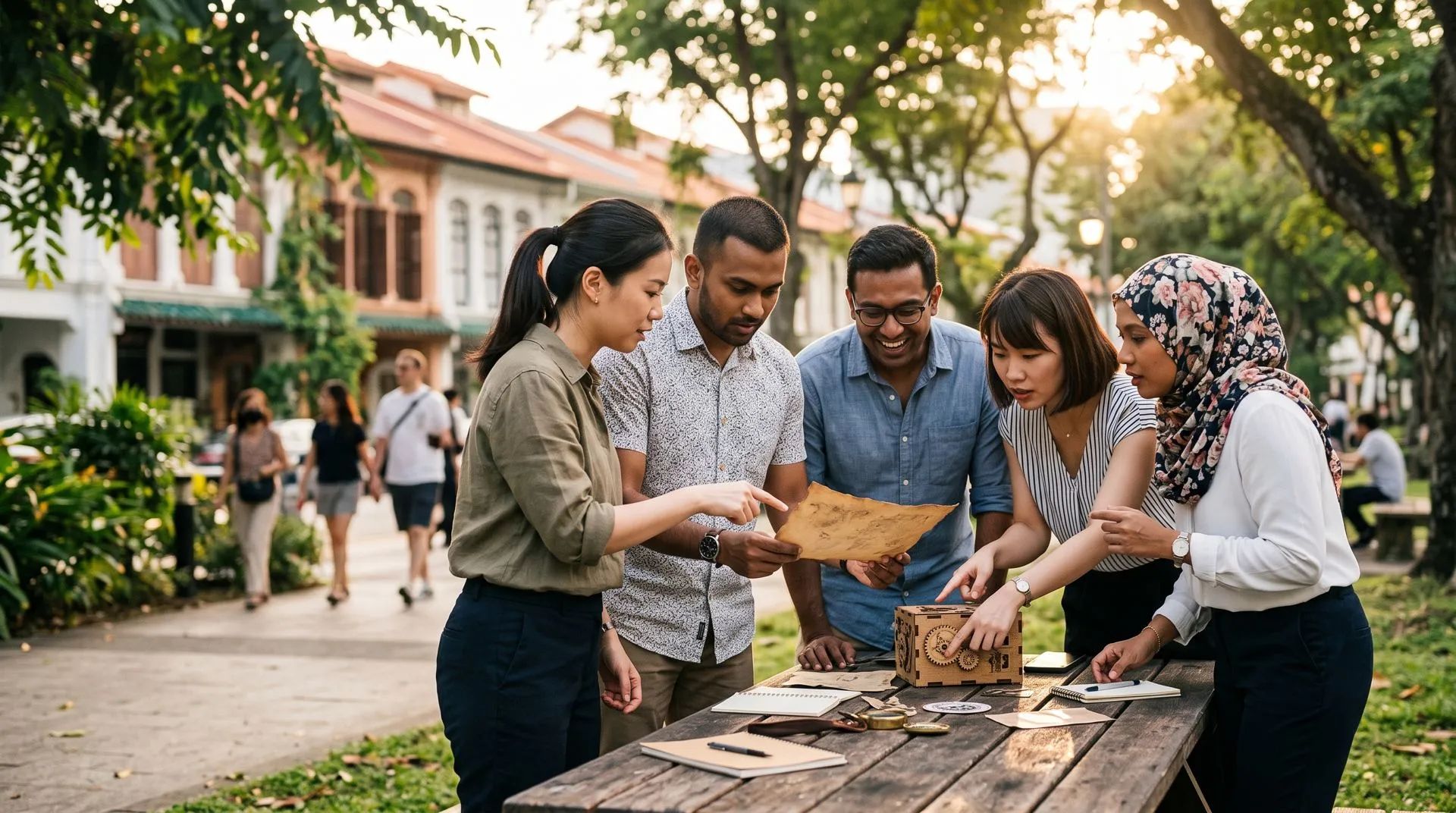
Quick answer: The seven problem-solving team building formats that work in Singapore are offsite escape games, amazing race routes, murder mysteries, build challenges, business simulations, cipher workshops and tabletop puzzle boxes, at roughly SGD 15 to 400 a head. Only the first two scale past about 200 pax playing at once, and an offsite escape game costs SGD 50 a head at 10 pax and about SGD 23 a head at 100.
| Format | Trains | Pax | SGD per pax | The catch |
|---|---|---|---|---|
| Offsite escape game | Problem solving against a clock, delegation | 10 to 1,000+ | 50 at 10 pax, about 23 at 100 (game fee) | Must be built to run in parallel |
| Amazing race or route game | Decisions on partial information | 20 to 1,000+ | 25 to 60 | Weather, and queues at checkpoints |
| Murder mystery | Listening, cross-checking claims | 10 to 60 | 50 to 100, dinner extra | Quiet people disappear |
| Build challenge | Prototyping to a spec | 20 to 200 | 25 to 60 | Can feel like school |
| Business simulation | Analysis and trade-offs | 15 to 100 | 100 to 400 | Feels like work |
| Cipher workshop | Pattern recognition, persistence | 10 to 40 | 30 to 70 | Closer to a class than an event |
| Puzzle box kit | Small-group sequencing | 8 to 40 | 15 to 35 | One strong solver carries the table |
Other vendors’ prices here are indicative bands drawn from public Singapore listings in October 2026, so check the figure at your real headcount before you budget. Ours come from our published formula.
“Something that makes them solve problems together” is one of the most common briefs we get, and one of the hardest to shop for. Search it and you get lists of activities that are fun but not actually puzzles, or puzzles that only work for eight people. Here is the shortlist, sorted by what each format does to a group rather than how it looks in photos.
First, the test that sorts them
A real problem-solving activity has three things. The team faces something they have not seen before, so nobody can coast on experience. There is a constraint, usually a clock, that stops the group from talking it to death. And the answer is not held by any one person, so information has to move between people or the thing does not get solved.
Miss any of the three and you have booked entertainment. Which is fine, if entertainment is what you wanted. Just do not expect the debrief to write itself.
The second test is scale. Most puzzle formats were designed for a table of six. Ask “can 200 people do this at the same time” before you fall in love with one.
The seven formats
1. Offsite escape games
Teams get a case, a two-hour clock and a chain of puzzles, run live by facilitators at a venue rather than in a fixed room. Many teams play the same case in parallel, so headcount is not the constraint it usually is.
- Trains: problem solving under time pressure, communication, delegation.
- Suits: 10 to 1,000+ pax. Department offsites, D&Ds, conferences, family days.
- Time: 120 minutes for most of our games. Journey into the Unknown, which runs at your own indoor venue, takes 90.
- Roughly: our Standard tier is SGD 300 fixed plus SGD 20 per person, so the game fee is SGD 50 a head at 10 pax, SGD 30 at 30 and about SGD 23 at 100. Some venues add an admission or venue fee on top. Lost Treasure of Sarang Rimau at Fort Siloso on Sentosa takes up to 1,000 pax and adds neither.
- The catch: a retail walk-in escape room is the opposite of this. It seats eight and everyone else waits. Check that the game was built to run in parallel.
This is what we do, so read it with that bias. How the format works.
2. Amazing race and city route games
Small teams move between checkpoints across a district or a large venue, solving a clue at each one, scored on time. The good ones tie every clue to the actual place instead of dropping generic stations onto a map.
- Trains: decision making with partial information, splitting work, navigation and pace.
- Suits: 20 to 1,000+ pax, groups that want to be outdoors and moving.
- Time: 2 to 3 hours.
- Roughly: SGD 25 to 60 a head from most Singapore vendors, falling toward the bottom of that band as the group grows. Admission is extra wherever the route passes through a paid attraction.
- The catch: weather, and bottlenecks. Ask how the operator staggers a large field so 600 people are not queueing at checkpoint three.
Our one true race is Race to Infinity, for up to 500 pax over 150 minutes. Our outdoor escape games borrow the checkpoint idea but tell one case from start to finish: how they compare with an amazing race.
3. Murder mystery and whodunit formats
Everyone gets a character and a set of private facts, and the group has to pool information to name a culprit. The puzzle is social rather than mechanical.
- Trains: listening, cross-checking claims, drawing conclusions from a group’s scattered knowledge.
- Suits: 10 to 60 pax, seated, often at a dinner. Talkative groups.
- Time: 2 to 3 hours, usually across a meal.
- Roughly: SGD 50 to 100 a head for the game, with dinner on top when it is catered.
- The catch: quiet people can disappear entirely. It rewards the confident, which is sometimes the opposite of what you booked it for.
4. Build and engineering challenges
Bridges from newspaper, towers from spaghetti, marble runs, egg drops. Teams get a physical constraint and a spec to hit.
- Trains: prototyping, testing an idea instead of arguing about it, working to a spec.
- Suits: 20 to 200 pax at tables, indoors, mixed ability.
- Time: 45 to 90 minutes.
- Roughly: SGD 25 to 60 a head with a facilitator. Materials are cheap, facilitation is the cost, and you can run a simple one yourself for close to nothing.
- The catch: they run short and can feel like a school activity if the framing is thin. Works better as one segment of a day than as the whole day.
5. Business simulations and case challenges
A fictional company, a set of numbers, and rounds where teams make decisions and see the results. The closest thing on this list to actual work.
- Trains: analysis, trade-offs, arguing for a decision with evidence.
- Suits: 15 to 100 pax, leadership and management groups, teams that want a training outcome on paper.
- Time: half a day at the short end, two days for a licensed programme.
- Roughly: SGD 100 to 400 a head for a facilitated half day, the highest band here. Licensed multi-day programmes cost far more.
- The catch: if people wanted a spreadsheet on a Friday afternoon they would have stayed at their desks. Read the room.
6. Code-breaking and cipher workshops
Ciphers, substitution puzzles, logic grids, worked through as a group with a facilitator teaching the technique as you go.
- Trains: pattern recognition, sticking with a problem past the point it feels impossible.
- Suits: 10 to 40 pax. Analytical teams, and student groups.
- Time: 90 minutes to 2 hours.
- Roughly: SGD 30 to 70 a head. Few Singapore vendors sell this off the shelf, so expect a custom quote.
- The catch: it is genuinely a puzzle activity, but it is closer to a class than an event. Not a D&D centrepiece.
7. Puzzle boxes and tabletop escape kits
A sealed box of locks and clues per table, no facilitator, run from a script.
- Trains: small-group collaboration, sequencing.
- Suits: 8 to 40 pax. Small offices, tight budgets, short slots.
- Time: about an hour.
- Roughly: SGD 15 to 35 a head, the lowest band on the list, and less again if the kit is bought once and reused.
- The catch: one strong solver can finish it while the other five watch. Fine for an hour, thin for a day.
Matching the format to what you were actually asked for
If the brief was “get the new joiners talking to the old hands”, pick something that forces information across the group: an escape game or a race, not a build challenge where the two engineers do all of it.
If it was “we want them to think”, a simulation or a cipher workshop puts the thinking front and centre, at the cost of atmosphere.
If it was “we have 400 people and a Friday”, the honest field narrows to two: an escape game run in parallel, or a route game with staggered starts. Everything else on this list either splits the group or leaves most of it watching.
What to ask the vendor
Four questions worth asking before you sign anything:
- How many people can genuinely play at once? Not “capacity”, which often means how many can stand in the room.
- What happens to a team that gets stuck? A good answer involves a hint system and a facilitator. A bad answer is silence for twenty minutes.
- Who is on site on the day? Ask for the number of staff, not the number of activities.
- What is the plan if it rains, or the venue changes? If the answer is improvised on the call, it will be improvised on the day too.
Planning one for a large group? Our large-group planning guide covers the run sheet, and there is an instant estimate if you need a number for a budget line this week.
Questions people ask
What is a problem-solving team building activity?
A problem-solving team building activity gives a team something it has not seen before, a constraint such as a clock, and information split across several people, so the group has to pool what it knows to finish. Offsite escape games, amazing races, murder mysteries, build challenges, business simulations and cipher workshops all qualify. Drop any of those three parts and you have booked entertainment instead.
Which problem-solving activity works for 100 or more people?
An offsite escape game or a route game with staggered starts, because both run the same challenge for many small teams at the same time. Most other puzzle formats were designed for a table of six to eight and leave a big group watching. An offsite escape game for 100 pax costs SGD 2,300 on our Standard tier, about SGD 23 a head, before any venue admission or hire.
How much does problem-solving team building cost in Singapore?
Most facilitated formats land between SGD 25 and 60 a head, and business simulations run far higher, often SGD 100 to 400. The per-head price falls as the group grows because a fixed facilitation cost is shared across more people. Our offsite escape game is SGD 300 fixed plus SGD 20 a head on Standard, which is SGD 50 a head at 10 pax and SGD 30 at 30.
Should a problem-solving activity be indoor or outdoor?
Either works, and the weather decides more than the format does. An escape game in a museum, a gallery or your own function room keeps heat and rain off the plan entirely. An outdoor route through Chinatown or Fort Siloso adds movement and a real sense of place, but it needs a rain plan, so ask the vendor what happens to the clock in a downpour.
How long should a problem-solving team activity last?
Ninety minutes to two hours suits most groups. Shorter and the team never gets past the warm-up, longer and energy drops unless the format keeps people moving. Most of our escape games run 120 minutes, Journey into the Unknown runs 90, and Race to Infinity runs 150. Build challenges usually fill 45 to 90 minutes, so they work best as one segment of a longer day.