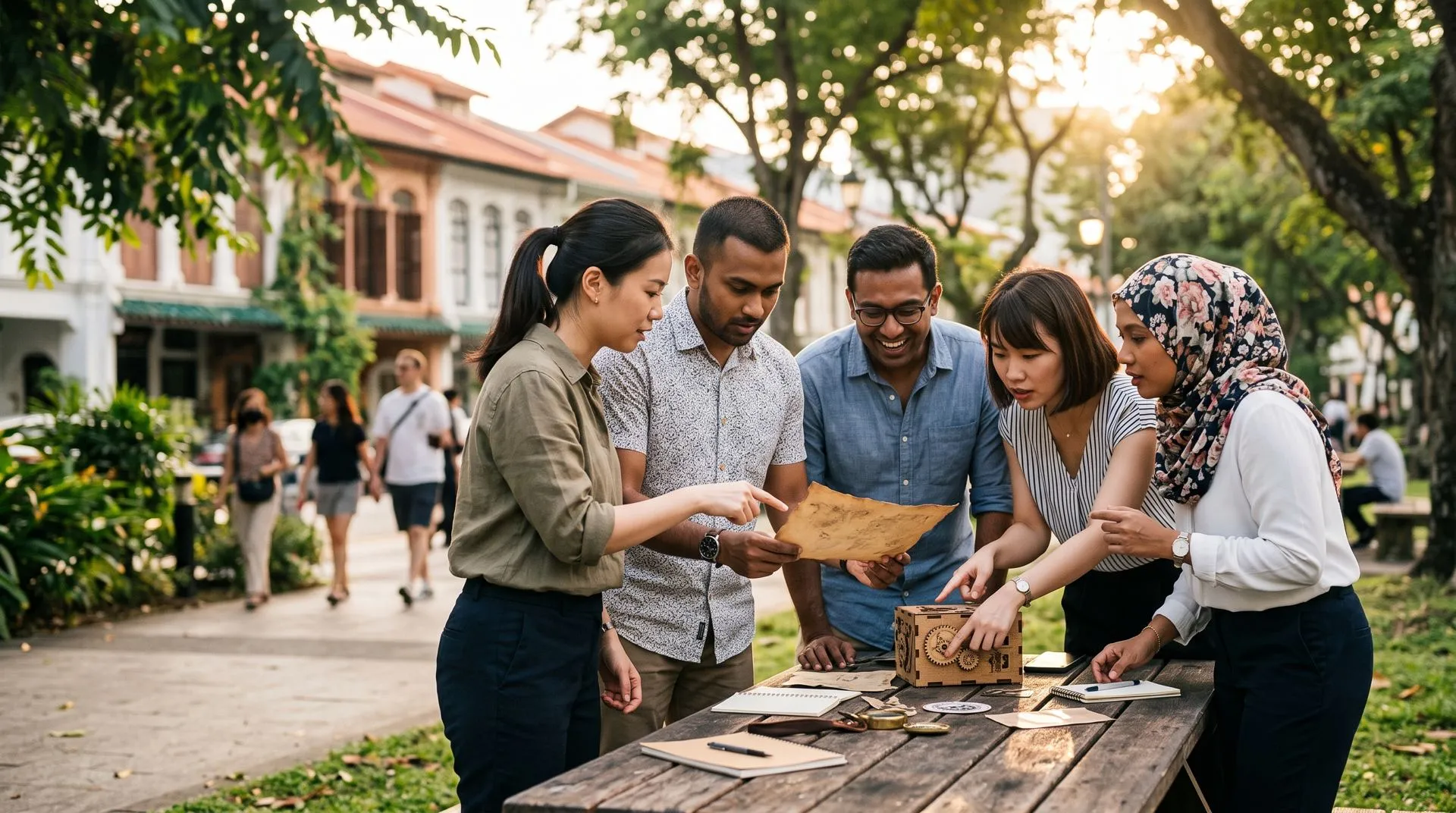
For a group of 100 to 1,000 pax in Singapore, pick a format where every team plays at the same time against one clock. An offsite escape game is built that way. Ours costs SGD 2,300 for 100 pax on Standard, about SGD 23 a head, and SGD 20,300 for 1,000 pax, about SGD 20.30 a head. That’s the game fee. Some venues add an admission or hire fee on top.
What moves the answer is mostly headcount. Every game has a cap, and some venues charge their own fee. The rest of this guide gives the numbers.
The Escape Artist has run escape games in Singapore since 2013 and now runs them entirely offsite, at venues such as Fort Siloso, Chinatown and the Asian Civilisations Museum, for 10 to 1,000+ pax. We sell one of the formats in this guide, so read it with that bias.
At a glance: 100, 200, 500 and 1,000 pax
| Group size | Standard game fee | Immersive game fee | Games that take everyone at once |
|---|---|---|---|
| 100 pax | SGD 2,300 (SGD 23 a head) | SGD 3,100 (SGD 31 a head) | Every game in the capacity table below |
| 200 pax | SGD 4,300 (SGD 21.50 a head) | SGD 5,100 (SGD 25.50 a head) | Lost Treasure of Sarang Rimau, Race to Infinity, Journey into the Unknown, Two Pieces, Whisper of the Guardians |
| 500 pax | SGD 10,300 (SGD 20.60 a head) | SGD 11,100 (SGD 22.20 a head) | Lost Treasure of Sarang Rimau, Race to Infinity |
| 1,000 pax | SGD 20,300 (SGD 20.30 a head) | SGD 21,100 (SGD 21.10 a head) | Lost Treasure of Sarang Rimau |
These are game fees, before any venue admission or hire. Race to Infinity and Journey into the Unknown are Immersive only, so use the Immersive column for those two. We’re not GST registered, so the price quoted is the price paid.
Which games hold a big group
An offsite escape game holds a big group when it was written to run across a whole venue, with many teams on the same case at once. Most advice on escape rooms for team building assumes a room that seats six to eight, which is why a group of 200 ends up queueing or split across several sessions. A game that sparkles for 50 can fall apart at 500, so ask for a real maximum before you fall for a concept.
These are the games we’d put in front of 100 pax or more, sorted by cap.
| Game | Where | Indoor or outdoor | Max pax | Minutes | Tiers |
|---|---|---|---|---|---|
| Lost Treasure of Sarang Rimau | Fort Siloso, Sentosa | Outdoor | 1,000 | 120 | Standard or Immersive |
| Race to Infinity | Any venue | Indoor and outdoor | 500 | 150 | Immersive only |
| Journey into the Unknown | Any indoor venue, including your office | Indoor | 300 | 90 | Immersive only |
| Two Pieces | Singapore Maritime Gallery, Marina South | Indoor | 200 | 120 | Standard or Immersive |
| Whisper of the Guardians | Chinatown | Outdoor | 200 | 120 | Standard or Immersive |
| Artefact Temporis | Asian Civilisations Museum, Civic District | Indoor | 150 | 120 | Standard or Immersive |
| Heart of the Ocean | Oceanarium, Sentosa | Indoor | 150 | 120 | Standard or Immersive |
| Wonderland | VivoCity, HarbourFront | Indoor | 120 | 120 | Standard or Immersive |
| Code of Silence | Battlebox, Fort Canning | Indoor | 120 | 120 | Immersive only |
The full list, with every game’s cap, is on our games page.
For 500 to 1,000 pax, Lost Treasure of Sarang Rimau at Fort Siloso on Sentosa is where we’d start. Teams follow a pirate’s clues across the ramparts and tunnels of Singapore’s only preserved coastal fort, and the fort is free to enter, so there’s no admission or hire to add to the game fee. A thousand people need room to spread out, and a fort has it.
For a group that wants to stay indoors, Journey into the Unknown runs in an office, a ballroom or a function hall for up to 300, and it’s the shortest game here at 90 minutes. Race to Infinity takes up to 500 and flexes to your location, part indoors and part out. It’s our one race format, with teams racing to retrieve five jewels.
For 120 to 200 pax with a building worth seeing, the museum and gallery games are the pick. Two Pieces at the Singapore Maritime Gallery and Artefact Temporis at the Asian Civilisations Museum both write their puzzles around what’s on display, so the venue does some of the work.
“Immersive only” means the game always comes with costumed facilitators stationed around the venue, and it’s priced on the Immersive fee.
How a large group actually runs
A large-group escape game runs as one briefing, then many small teams playing the same case at the same time, each on its own route, against one clock. Parallel play is the whole trick. When a few hundred people are all solving at once, nobody is left in the audience.
One briefing for the whole room
Our host briefs everyone at once, splits the group into teams and hands out the physical kits. It takes about half an hour, and it’s the only point in the day when everyone needs to hear the same thing at the same moment. If you’re in a ballroom, ask the venue whether the house microphone comes with the room.
Parallel routes, so nobody queues
Scale is where most group games fall over. One checkpoint jams and the whole field stacks up behind it. MazeFox, our own web app, gives every team a different order of stops through the same story, so no two teams reach the same puzzle at the same moment. Teams play on their own phones in an ordinary browser, and there’s nothing to download.
One clock, one scoreboard
Everyone starts together and everyone finishes together. Live scoring records finish times, hints taken and wrong turns, so there’s a real result at the end, and the scoreboard goes up at the reveal. That shared finish is what makes 500 people feel like one event.
Waves, when everyone can’t be away at once
Sometimes the whole group can’t leave together. An operations team on shifts is the usual case, or a venue that won’t hold everyone. Then the game runs in waves on the same day, say a morning group and an afternoon group, each playing the full game. Waves cost you the shared finish, so treat them as the fallback. If you need them, say so in the enquiry.
Who runs it
Both tiers run on MazeFox with a host from our team, who runs the briefing, the game and the finish. When a team gets stuck, the app gives progressive hints, so nobody sits stranded on one puzzle while the rest move on. Immersive adds costumed facilitators stationed around the venue, who can step in too. At 500 pax or more, ask how many of our people will be on the ground and get the answer in writing.
What you provide
- A headcount range now, a final number later. The final figure is due by the date in your proposal.
- How the teams are split. We recommend 2 to 8 a team. Mixing departments is usually the point of a big day, so decide early whether you assign teams or let people pick.
- Phones. At least one charged phone with mobile data per team.
- At your own venue, a room big enough to seat your teams and somewhere for us to set up at the front. No projector, no special power.
- Food, transport and prizes, unless you’d rather we add them to the proposal, which we can. One proposal beats chasing five vendors.
If you’re still deciding whether a game is the right kind of team day at all, our page on escape game team building covers the format and how it compares with a walk-in room.
What it costs
The game fee for a large group is SGD 300 fixed plus SGD 20 per person on Standard, or SGD 1,100 fixed plus SGD 20 per person on Immersive.
The per-head cost falls as the group grows because the fixed part spreads across more people. On Standard that’s SGD 23 a head at 100 pax, SGD 21.50 at 200, SGD 20.60 at 500 and SGD 20.30 at 1,000.
The gap between the tiers shrinks the same way. Immersive costs SGD 800 more than Standard at any size, which is SGD 8 a head at 100 pax, SGD 1.60 at 500 and 80 cents at 1,000. For a flagship company day of several hundred people, that’s a small line to argue about.
The total is the game fee plus whatever the venue charges, and that depends on the venue:
- Nothing to add: Fort Siloso, Chinatown, the Singapore Maritime Gallery, VivoCity, and your own office.
- An admission ticket per head: the Oceanarium on Sentosa.
- Depends on the group: the Asian Civilisations Museum is free for Singaporeans and PRs, and foreign visitors pay.
- Venue hire: the Battlebox at Fort Canning, where the hire already includes admission.
- A venue we find for you: that venue sets its own fee.
We set the venue’s charge out as its own line in the quote, so finance can see it.
Our quote calculator gives you the game fee for your exact headcount straight away. For the lines a finance team will ask about, see our guide to budgeting a corporate offsite.
When to start planning: from the first date to the day
Start as soon as you have a date in mind. How far ahead you need depends on the venue’s calendar, not on your headcount: a weekday at a free venue can come together quickly, while a Saturday at a popular attraction may already be taken. November and December are dinner and dance (D&D) season, when the good slots genuinely run out, so start earlier for those.
As soon as you have a date
- Lock a date and a headcount range. You don’t need a final number. “200 to 250” is enough, and so are two dates to hold. Venues and facilitator crews fill up, so this goes first.
- Pick indoor or outdoor, and shortlist games whose cap clears the top of your range.
- Get the game fee in writing before you take it to anyone internally.
- Start the vendor paperwork if payment runs through GeBIZ, Vendors@Gov or a company vendor portal.
Once the date is held
- Choose Standard or Immersive. For a flagship company day, Immersive earns its keep. For a simpler energiser, Standard does the job.
- Confirm the event and the venue.
- Add catering, transport and prizes to the same proposal.
- Send a one-line calendar invite with the time and the meeting point. Players don’t need to prepare anything, so save the rest for the day.
Before the day
- Send the final headcount by the date in your proposal. Part of the fee is per person, so this number sets the final figure.
- Send team lists if you’re assigning teams.
- Check the forecast for an outdoor game. If it looks bad well ahead of the day, we’ll offer an indoor game or a new date.
- Remind everyone to bring a charged phone, and comfortable shoes and water for an outdoor game.
On the day
- Block out three hours. About half an hour for arrival and the briefing, two hours of play (90 minutes on Journey into the Unknown, 150 on Race to Infinity), then half an hour for the reveal and the scoreboard.
- Plan the arrival. If 500 people are coming by coach, sort out the drop-off point and where everyone gathers before the briefing.
- Play. Our host runs the briefing, the game and the finish. The person who organised the day should be on a team, not holding a clipboard.
- Eat afterwards, or during. Most clients build the game into a half day with catering, or run it through a D&D dinner in the evening.
What else works at scale
We run offsite escape games, so weigh this with that in mind. These formats hold a big group too, each with a catch.
- A table game at a dinner and dance. Every table is a team and nobody leaves their seat for long. It usually runs right through the dinner, between courses, and it’s a segment rather than a whole offsite. Our D&D game ideas cover the options.
- A route game or amazing race. Teams move between checkpoints, which suits a group that wants to be outdoors and moving. The risk is bottlenecks, so ask how a field of 600 is staggered. Race to Infinity is ours.
- Telematch or a sports day. Cheap, loud and scalable if you have a field. The catch is anyone who can’t or won’t run. Give them scoring or referee jobs instead of a bench.
- A game show with a host. Teams at tables, a scoreboard on screen. Easy in a ballroom, but it entertains more than it gets people working together.
- A keynote or a talk. Everyone’s in the room and nobody’s doing anything together. Fine for a message, weak as team building.
Our guide to team building activities in Singapore compares more of them for groups too big for one room.
Before you ask for a quote
You don’t need every detail to start. Group size, a rough date, and whether you’d rather be indoors or out are enough for a first number.
Get a quote for your headcount, or tell us about the day and we’ll come back with a proposal.
Questions people ask
How many people should be in each team for a large group?
We recommend 2 to 8 a team, and within that range you decide. Smaller teams mean everyone gets their hands on a clue. Bigger teams mean fewer teams to manage and more departments mixed together. At 500 pax in teams of six you would have about 84 teams, and our web app gives each one its own route, so more teams do not create queues.
How long does a team building escape game take for a large group?
Block out three hours. The game itself runs two hours on most of our games, 90 minutes on Journey into the Unknown and 150 minutes on Race to Infinity. Add about half an hour before for arrival, the briefing and team formation, and half an hour after for the reveal and the scoreboard. A bigger headcount does not make the day longer, because every team plays at the same time.
How far ahead should we plan team building for 200 or 500 people?
As early as the venue allows. The lead time depends on when the venue is free, not on how many people are coming, so a quiet weekday can come together far faster than a Saturday at a popular attraction. Send us the date as soon as you have one, then leave time to get the fee approved and finish any vendor registration. November and December are dinner and dance season, when the good slots run out first. The final headcount comes later, by the date set in your proposal.
How much does team building cost per pax for 200 or 500 people in Singapore?
For an offsite escape game, the game fee for 200 pax is SGD 4,300 on Standard, which is SGD 21.50 a head. For 500 pax it is SGD 10,300, or SGD 20.60 a head. Immersive adds SGD 800 to the total at any size. Some venues charge their own admission or hire fee on top. We are not GST registered, so the price quoted is the price paid.
Is indoor or outdoor better for a large group?
Outdoor holds the biggest groups. Lost Treasure of Sarang Rimau takes up to 1,000 pax across Fort Siloso on Sentosa, and the fort is free to enter. Indoor suits a group that wants air-conditioning and no weather risk. Journey into the Unknown runs in your own office or ballroom for up to 300, and our indoor venue games take 120 to 200 pax each.
What happens if it rains during an outdoor team building game?
The game pauses rather than ends. Every outdoor route has sheltered hold points, so teams wait out a passing shower and the clock stops for everyone at once. If the forecast looks bad well ahead of the day, we offer you an indoor game or a new date instead. We have run games in Singapore since 2013, so the weather is planned for, not hoped about.