Eight of these 12 Chinese New Year games cost SGD 10 a head or less, and an office can run all eight itself without hiring anyone. Chinese New Year 2027 falls on Saturday 6 February, the first day of the Year of the Goat, so most offices will celebrate in the week before or the fortnight after. Headcount, and whether anyone wants to leave the building, decide the rest.
We run number 12, so read that one with the bias in mind.
| Game | Pax | Minutes | Indoor or outdoor | Rough SGD per head |
|---|---|---|---|---|
| 1. Office lo hei | 4 to 10 a platter, any number of tables | 10 to 15 | Indoor | 3 to 15 |
| 2. Chopstick bean race | 10 to 200, in heats | 15 to 20 | Indoor | Under 1 |
| 3. Mandarin orange pyramid | 10 to 100, teams of 5 | 15 | Indoor | Free |
| 4. Red packet coin toss | 10 to 300, drop-in | 60 to 120 as a station | Indoor | 2 to 5, in prizes |
| 5. Year of the Goat quiz | 10 to 500 | 20 to 30 | Indoor or online | Free |
| 6. Guess the four-character saying | 10 to 80, in teams | 20 to 30 | Indoor | Free |
| 7. Lantern riddles | The whole office | Drop-in over two weeks | Indoor | Under 2 |
| 8. Red packet lanterns | 10 to 60 | 45 to 60 | Indoor | Free |
| 9. Department decoration contest | 30 to 500, by department | A week to build, 30 to judge | Indoor | 2 to 10 |
| 10. Calligraphy or paper-cutting workshop | 10 to 40 a session | 60 to 90 | Indoor | 30 to 60 |
| 11. Lion dance | Any crowd that can see | 15 to 30 | Lobby or entrance | Flat fee, about 400 to 2,000 |
| 12. Offsite escape game in Chinatown | 10 to 200 | 120 | Outdoor | 21.50 to 50, game fee |
Bands for other people’s activities are indicative, not quotes. Ours come from our published formula.
The 2027 dates that matter at work
Chinese New Year 2027 falls on Saturday 6 and Sunday 7 February, according to the Ministry of Manpower’s public holiday list, and the season runs 15 days.
| Date | Day | What it means for the office |
|---|---|---|
| 5 February 2027 | Friday | CNY eve and the reunion dinner. Not a public holiday, though many offices let people leave early |
| 6 and 7 February | Saturday and Sunday | Chinese New Year, both public holidays |
| 8 February | Monday | A public holiday for staff whose rest day is Sunday 7 February |
| 12 February | Friday | Renri, the seventh day, when lo hei is traditionally tossed |
| 20 February | Saturday | Chap Goh Mei, the 15th day and the Lantern Festival, which closes the season |
So a Monday to Friday office has two windows: the week of 1 February, and Tuesday 9 to Friday 19 February. Lion dance troupes and restaurants are in most demand just after the holiday, so settle those dates in December.
Games the office can run itself, from free to SGD 15 a head
None of these nine needs a vendor. Most need a meeting room, a lunch hour and someone willing to hold a stopwatch.
1. An office lo hei
A lo hei is the Singapore custom of tossing yu sheng, a raw fish salad, as high as you can with chopsticks while shouting good wishes for the year. Nearly every office expects one, and it scales: every table tosses its own platter at the same moment.
- Suits: 4 to 10 people a platter, any number of tables.
- Time: 10 to 15 minutes, longer if you eat it after.
- Roughly: SGD 3 to 15 a head. A supermarket yu sheng set is the cheap end, a restaurant takeaway platter the dear one.
- The catch: it gets everywhere. Toss over a table you can wipe, not the carpet, and order a halal or vegetarian platter for any table that needs one.
How to run it, and what to say, is further down.
2. Chopstick bean race
Each player gets chopsticks and 30 seconds to move as many dried red beans as they can from one bowl to another. Run heats, then a final in front of everyone.
- Suits: 10 to 200 pax, in heats of 6 to 10.
- Time: 15 to 20 minutes.
- Roughly: under SGD 1 a head, for beans, paper bowls and disposable chopsticks.
- The catch: use beans or wrapped sweets, never peanuts, because someone has an allergy. Give anyone who rarely uses chopsticks a practice round first.
3. Mandarin orange pyramid
Mandarin oranges arrive in every office pantry by the box. Give teams of five 20 oranges and two minutes to build the tallest freestanding pyramid. Twenty is exactly enough for a four-layer triangular one, if anybody works that out.
- Suits: 10 to 100 pax, in teams of 5.
- Time: 15 minutes.
- Roughly: free, with the oranges already in the pantry.
- The catch: bruised fruit. Eat them that afternoon, and leave the pair on reception out of it.
4. Red packet coin toss
Tape a grid of red packets to a table, each marked with a prize, and give every player three tokens to toss from behind a line. Land on a packet, win what it says. It works best as a drop-in station over a long lunch.
- Suits: 10 to 300 pax, drop-in.
- Time: an hour or two as a station, about 30 seconds a player.
- Roughly: SGD 2 to 5 a head, which is the prize budget. An extra hour off on a Friday costs nothing and gets the loudest cheer.
- The catch: keep staff money out of it. The company supplies the tokens and pays for the prizes, and playing is free. That keeps it a game rather than gambling, which matters in Singapore (see the FAQs).
5. A Year of the Goat quiz
Twenty questions on a screen, answered on phones through any quiz app. Mix the zodiac with the customs: which animal comes before the Goat (the Horse), what the 15th night is called (Chap Goh Mei), why oranges go in pairs.
- Suits: 10 to 500 pax, and remote staff can join.
- Time: 20 to 30 minutes.
- Roughly: free, though free tiers of quiz apps cap the number of players.
- The catch: a quiz only Chinese colleagues can answer is an in-group test. Write questions that teach something, and mix every team.
6. Guess the four-character saying
Most CNY greetings are four-character phrases, like gōng xǐ fā cái. Write a dozen on cards in pinyin and English, then have teams act them out or draw them against a two-minute clock.
- Suits: 10 to 80 pax, in teams of 4 to 6.
- Time: 20 to 30 minutes.
- Roughly: free. The yu sheng sayings below make a ready-made deck.
- The catch: language. Put a Mandarin speaker in every team and accept the English meaning as a correct answer, or half the room sits it out.
7. Lantern riddles
Guessing riddles hung from lanterns is the traditional game of the Lantern Festival. Hang paper lanterns around the office with a riddle on each, and give people until Friday 19 February, the last working day before Chap Goh Mei, to solve them.
- Suits: the whole office, each at their own pace.
- Time: a few minutes a riddle, across two weeks.
- Roughly: under SGD 2 a head, for lanterns and a prize.
- The catch: someone has to write 20 good riddles, which takes longer than it sounds. Write them in English as well as Chinese.
8. Red packet lanterns
Last year’s unused red packets fold and staple into hanging lanterns and fish. Put packets, staplers and string on a table over lunch and let people drop in. It’s the quietest item here, and the one people keep at their desks.
- Suits: 10 to 60 pax, at tables.
- Time: 45 to 60 minutes.
- Roughly: free, if staff bring old packets from home.
- The catch: each lantern eats a stack of packets, so ask for donations in January.
9. Department decoration contest
Each department gets a week and a small budget to dress its corner of the floor, and the whole office votes on the Friday.
- Suits: 30 to 500 pax, by department.
- Time: a week to build, 30 minutes to judge.
- Roughly: SGD 2 to 10 a head. Cap it at SGD 50 to 100 a team, so ideas win rather than spending.
- The catch: building management. No candles, nothing hung from sprinklers, exits kept clear. And agree now who takes it down after Chap Goh Mei.
Worth hiring in
10. Calligraphy or paper-cutting workshop
A calligrapher teaches the team to brush 福 (fú, good fortune) or 春 (chūn, spring), and everyone takes their sheet home. Hang the 福 upside down: “upside down” is dào, which sounds like “arrived”, so fortune has arrived. Paper-cutting, 剪纸 (jiǎn zhǐ), works the same way with scissors.
- Suits: 10 to 40 pax a session.
- Time: 60 to 90 minutes.
- Roughly: SGD 30 to 60 a head, indicative, with materials.
- The catch: it’s quiet and seated, so people talk to their own table. Good for one department, weaker for mixing a company.
11. A lion dance
Two lions, a drum and cymbals, ending with cai qing (采青, cǎi qīng): the lion takes a lettuce with a red packet tied to it from the host, usually the most senior person present, and scatters the leaves over the crowd for luck.
- Suits: any crowd that can see the lobby or the entrance.
- Time: 15 to 30 minutes.
- Roughly: a flat fee per performance, indicatively SGD 400 to 2,000, depending on the number of lions, the length and the date.
- The catch: it’s a show, so most of the room watches rather than plays. It’s also loud, so clear it with building management and warn the neighbours.
Taking it out of the office
12. An offsite escape game in Chinatown
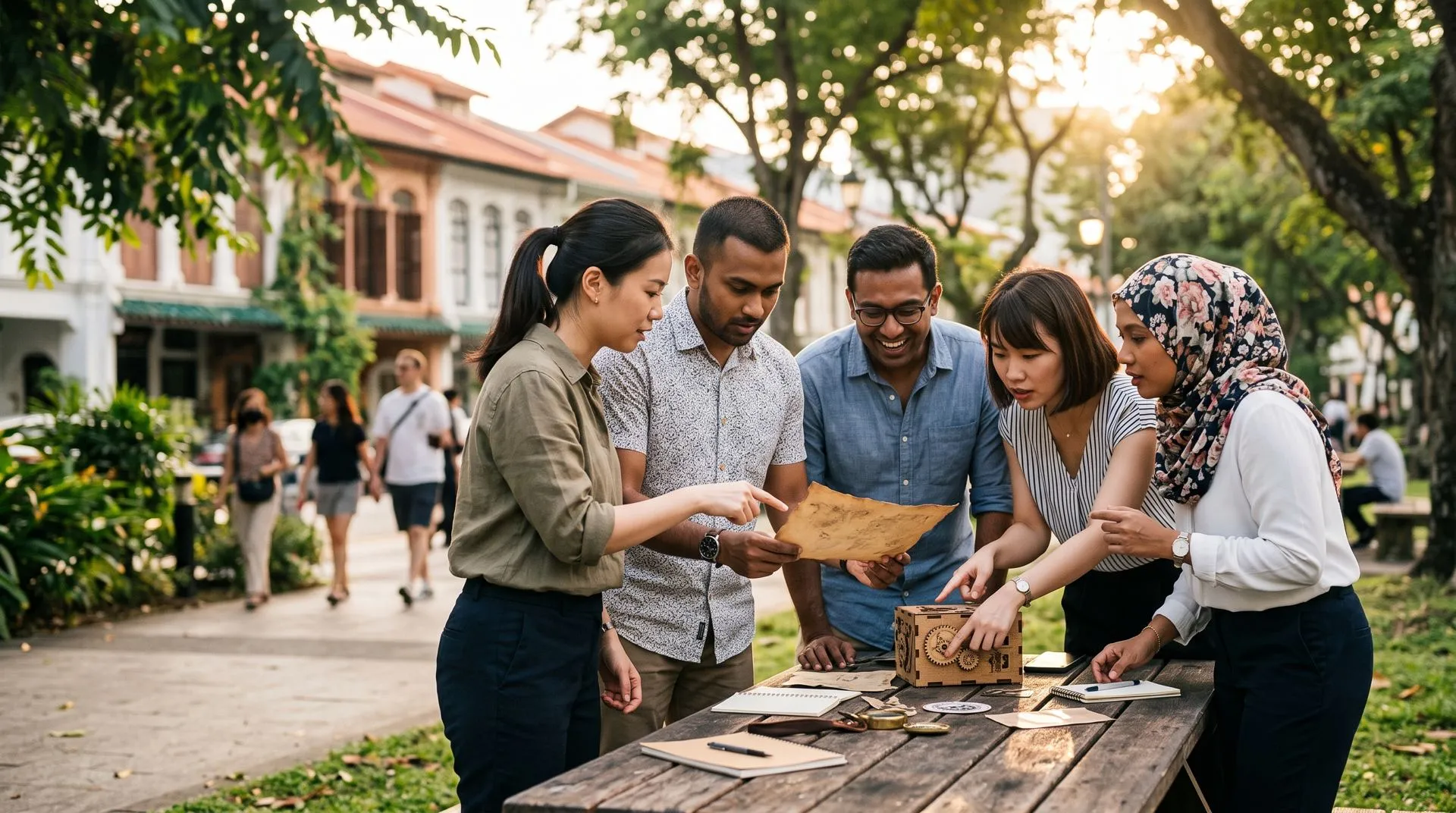
An offsite escape game is a live, facilitated game that teams play across a real place, solving a chain of puzzles against a clock. Ours in Chinatown is Whisper of the Guardians: a shophouse owner finds a scroll leading to treasure hidden by Chinese merchants during the Second World War, and your teams chase its clues through the streets. There’s no CNY storyline, but Chinatown is where the season is most visible, and there are restaurants for a CNY dinner on every corner once the game is done.
- Suits: 10 to 200 pax, in teams, all playing at once.
- Time: 120 minutes.
- Roughly: the game fee is SGD 300 plus SGD 20 a head on Standard, so SGD 1,300 for 50 people (SGD 26 each) and SGD 2,300 for 100 (SGD 23 each). Immersive, which adds facilitators in costume around the route, is SGD 1,100 plus SGD 20 a head. Chinatown charges no admission or venue fee, and we’re not GST registered, so the price quoted is the price paid.
- The catch: it’s outdoors. February is usually one of Singapore’s drier months, and rain pauses the clock at sheltered hold points, but it’s still the street. Chinatown is also packed in the weeks before CNY, so a weekday after the holiday plays better.
For more than 200, Lost Treasure of Sarang Rimau at Fort Siloso on Sentosa takes up to 1,000. Our Chinese New Year company events page has the rest.
How to run a lo hei at the office
A lo hei takes 10 to 15 minutes at a table of up to 10, and it needs one person who knows the order. Lo hei is Cantonese for “toss up” (捞起, lāo qǐ in Mandarin). The dish is yu sheng (鱼生, yú shēng), raw fish, and yú also sounds like the word for abundance. Tradition puts the toss on renri, the seventh day, but Singapore offices toss from the week before the holiday to Chap Goh Mei.
- Everyone stands round the table with chopsticks. Whoever knows the words leads, and that isn’t always the boss.
- The leader opens with gōng xǐ fā cái (wishing you prosperity) and wàn shì rú yì (may everything go as you wish).
- The ingredients go on one at a time, each with its saying. Follow the restaurant’s card where its order differs from the table below.
- Everyone tosses together, as high as they dare, shouting “lo hei!” and “huat ah!”, Hokkien for “prosper”. The higher the toss, the better the year.
- Eat it, or don’t. Nobody minds a platter that ends up mostly on the table.
For 100 or more, put a platter on every table and have the emcee call each saying from the front, so the whole room tosses on one count.
Yu sheng sayings and what they mean
This is a common Singapore order. Restaurants and families vary it.
| Ingredient | Saying (hanyu pinyin) | Chinese | Meaning |
|---|---|---|---|
| Raw fish | nián nián yǒu yú | 年年有余 | Abundance year after year |
| Pomelo or lime | dà jí dà lì | 大吉大利 | Great luck and great profit |
| Pepper and five-spice powder | zhāo cái jìn bǎo | 招财进宝 | Bring in wealth and treasure |
| Oil | yī běn wàn lì | 一本万利 | Ten thousand times the return on your capital |
| Oil, second saying | cái yuán guǎng jìn | 财源广进 | Money flowing in from every direction |
| Carrot | hóng yùn dāng tóu | 鸿运当头 | Good luck is on its way |
| Green radish | qīng chūn cháng zhù | 青春常驻 | Stay young forever |
| White radish | bù bù gāo shēng | 步步高升 | Rise higher with every step, a promotion at work |
| White radish, second saying | fēng shēng shuǐ qǐ | 风生水起 | Fast progress, a business on the rise |
| Crushed peanuts | jīn yín mǎn wū | 金银满屋 | A house full of gold and silver |
| Sesame seeds | shēng yì xīng lóng | 生意兴隆 | A thriving business |
| Golden crackers | mǎn dì huáng jīn | 满地黄金 | Gold all over the floor |
| Plum sauce | tián tián mì mì | 甜甜蜜蜜 | Sweetness, in life and between people |
| The toss | shēn tǐ jiàn kāng | 身体健康 | Good health |
Red packets and mandarin oranges at work
Married people give red packets (hongbao, or ang bao in Hokkien) to those who aren’t married, so in many offices a married manager gives one to each unmarried member of the team, and plenty simply give to everyone. Some companies hand every employee one on the first working day back. Single colleagues aren’t expected to give.
- Amounts: even numbers, never with a 4, since sì (four) sounds like the word for death.
- Notes: new notes, or a PayNow e-hongbao for a hybrid team.
- Manners: give and receive with both hands, and don’t open it in front of the giver.
- Oranges: always in pairs. A visitor brings two and leaves with two. At the office, a box in the pantry does the job.
Keeping it inclusive
Singapore offices are mixed, and CNY at work goes best when nobody is tested on it. Order halal or vegetarian yu sheng where needed. Ramadan is expected to begin around 8 February 2027, subject to the MUIS announcement, so a lunchtime lo hei after the holiday lands in fasting hours: hold it in the week of 1 February, or ask. And run every game in English, with pinyin alongside the Chinese.
What we’d run, by headcount
- 20 people, one meeting room: a lo hei, the chopstick race and the quiz. About SGD 5 to 15 a head, done in an hour.
- 100 people, one floor: a lo hei at every table led from the front, the coin toss as a lunch station, and lantern riddles across the fortnight.
- 200 people who want out of the office: a lo hei at the office in the week of 1 February, then an offsite escape game in Chinatown on a weekday after the holiday. At 200 pax on Standard the game fee is SGD 4,300, or SGD 21.50 a head.
If the company’s dinner and dance (D&D) is this year’s CNY celebration, these D&D games work seated for 100 or more.
To price a game for your headcount and date, get an instant estimate.
Questions people ask
When is Chinese New Year 2027 in Singapore?
Chinese New Year 2027 falls on Saturday 6 February and Sunday 7 February, and it starts the Year of the Goat. Both days are public holidays. Because the second day is a Sunday, Monday 8 February is also a public holiday for anyone whose rest day is 7 February, which covers most office staff. The festive season runs 15 days and ends on Chap Goh Mei, Saturday 20 February 2027.
What can we do for Chinese New Year at the office?
Start with a lo hei, which takes about 15 minutes and works for any headcount when every table tosses its own platter. Add one or two games the office can run itself, such as a chopstick bean race, a CNY quiz or lantern riddles, which cost little or nothing. For a bigger celebration, hire a lion dance or take the team out of the office for an offsite escape game in Chinatown.
How long does a lo hei take?
A lo hei takes 10 to 15 minutes from opening the platter to the last toss. Adding the ingredients one at a time, with a saying for each, takes most of that, and the toss itself lasts a minute or two. Allow another 15 to 20 minutes if people will eat the yu sheng afterwards, and a little longer if one emcee is leading many tables at once.
What CNY games work for a large group of 100 or more?
For 100 or more, pick games that run in parallel so nobody waits for a turn. A lo hei works at every table at the same moment, a CNY quiz runs on phones for hundreds, and a chopstick race works in heats of ten. To take a large group out of the office, an offsite escape game in Chinatown takes up to 200 players at once, and Fort Siloso on Sentosa takes up to 1,000.
Is gambling allowed at an office CNY party in Singapore?
Keep staff money out of it. Singapore's social gambling exemption covers family and friends playing in a private home, so card games or mahjong for money at the office fall outside it. A company can run a free lucky draw or game of chance for attendees, with prizes the company pays for, under the Gambling Regulatory Authority's class licence for incidental games, with no application needed. Read the GRA's conditions first.
Can Muslim and vegetarian colleagues join a lo hei?
Yes, with a little planning. Halal-certified and vegetarian yu sheng are both sold in Singapore, so order one for any table that needs it. In 2027 Ramadan is expected to begin around 8 February, subject to the MUIS announcement, so a lunchtime lo hei after the holiday falls in fasting hours. Holding it in the week of 1 February, or simply asking colleagues what suits them, avoids the clash.